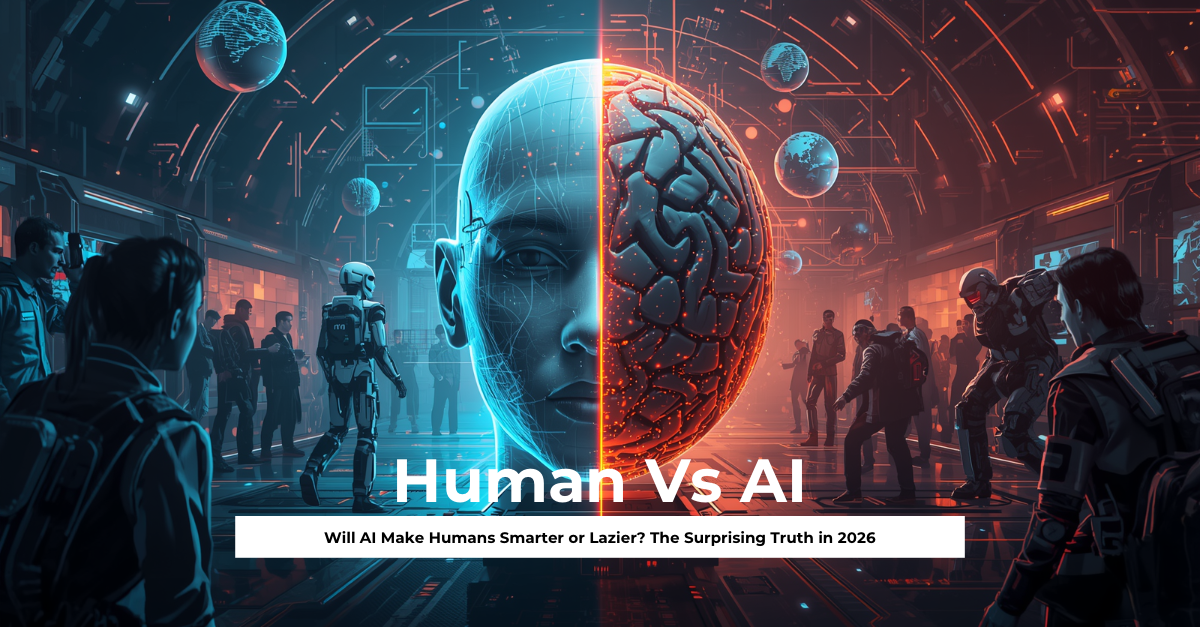
Will AI Make Humans Smarter or Lazier? The Surprising Truth in 2026
When everything becomes easier, will our brains develop or decline?
That single question hits hard in 2026. AI is no longer a futuristic concept — it’s the co-pilot in your phone, the writer of your emails, the planner of your meals, and sometimes even the thinker behind your decisions. We love the convenience. Yet deep down many of us worry: are we getting sharper, or are we quietly getting softer?
If you’ve ever felt a little uneasy after asking an AI tool to solve something you used to figure out yourself, you’re not alone. This article is for you. We’re going to explore both sides honestly, share real stories from 2026, look at what’s happening inside our brains, and most importantly, give you practical ways to make sure AI becomes a tool that lifts you up instead of holding you back. By the end, you’ll have a clear picture and a simple action plan you can start using today.
When Everything Becomes Easier, Will Your Brain Develop or Decline?
Let’s be real for a second. Life feels easier than ever. Need to write a report? AI drafts it in seconds. Forgot how to cook that recipe? AI gives you step-by-step instructions with your fridge ingredients. Stuck on a math problem? AI explains it better than your old teacher.
The convenience is addictive. But here’s the uncomfortable truth: when tools do the heavy lifting for our brains, we risk losing the very muscles that made us smart in the first place. It’s like having a personal gym trainer who lifts all the weights for you — you might feel great in the moment, but your own strength slowly fades.
The good news? It doesn’t have to be this way. AI can be an incredible amplifier of human intelligence if we use it consciously. The choice is ours, and 2026 is the perfect year to make that choice deliberately.
Understanding the AI Revolution Happening Right Now in 2026
AI has matured fast. What started as basic chatbots a few years ago has become sophisticated systems that can reason, create, and even anticipate needs before we ask. In 2026, AI agents handle entire workflows — booking travel, managing finances, coding entire apps, and providing medical insights that rival specialists.
What AI Actually Looks Like in Everyday Life This Year
Walk into any office or home and you’ll see people talking to their screens like old friends. Students use AI tutors that adjust difficulty in real time. Professionals lean on AI to analyze data and suggest strategies. Even creative fields like design and music now have AI collaborators that generate ideas in seconds.
From Smart Assistants to Autonomous Decision-Makers
The leap from assistant to decision-maker is the biggest shift this year. AI doesn’t just answer questions anymore — it makes suggestions and sometimes acts on them with minimal human input. This power is incredible, but it also creates the perfect environment for mental laziness to creep in.
The Bright Side – How AI Can Truly Make Us Smarter
AI isn’t the enemy of intelligence. Used correctly, it can make us significantly smarter than previous generations.
Supercharged Learning and Instant Knowledge Access
Remember when learning something new meant hours in the library or watching confusing YouTube videos? Now AI can explain complex topics at exactly your level of understanding. It adapts, repeats, tests you, and fills knowledge gaps instantly. This democratization of education is unprecedented.
Personalized AI That Adapts to Your Unique Brain
The best AI tutors in 2026 don’t teach the same way to everyone. They study how you learn best — visual, auditory, hands-on — and adjust on the fly. People who once struggled in traditional classrooms are suddenly excelling because the teaching style finally matches their brain.
Boosting Creativity and Problem-Solving
Here’s something beautiful: AI handles the boring, repetitive parts of creative work, freeing humans to focus on the truly original ideas. Writers use AI for structure and research so they can pour energy into storytelling. Designers generate dozens of variations quickly and pick the ones that spark joy. The result? More innovation, not less.
The Hidden Danger – Why AI Might Be Making Us Lazier
But there’s another side, and we’d be foolish to ignore it.
The Convenience Trap That Steals Your Mental Effort
When AI can do something faster and often better, the temptation to skip the thinking process becomes huge. Why struggle with a problem for thirty minutes when AI can solve it in ten seconds? Over time, that “struggle muscle” weakens.
Real Signs of Cognitive Slip You Might Already Notice
Many people in 2026 report feeling mentally foggy when AI is turned off. They struggle to remember information they used to know cold. Simple mental math feels harder. Attention spans have shortened even more. These aren’t coincidences — they’re symptoms of a brain that’s outsourcing too much work.
Over-Reliance and the Slow Erosion of Basic Skills
Think about it like this: if you always use GPS, your natural sense of direction slowly fades. The same principle applies to thinking. When AI writes our emails, summarizes our reading, and plans our days, we gradually lose practice in those fundamental skills.
The Psychological Reality – What’s Happening Inside Your Brain
Neuroscience in 2026 shows clear patterns.
Neuroplasticity in the Age of Instant Answers
Your brain is incredibly adaptable. When you stop using certain neural pathways, those connections weaken. Constant AI assistance means fewer opportunities for deep focus and complex problem-solving — exactly the activities that build stronger brains.
Motivation, Dopamine, and the Laziness Loop
AI gives us quick wins and instant gratification. That feels good in the moment, but it trains our brain to crave easy rewards. Over time, the motivation to tackle hard things on our own can diminish. It’s a subtle but powerful laziness loop.
Real-World Examples and Stories from 2026
People Who Used AI to Become Sharper and More Successful
Take Sarah, a marketing manager in Bangkok. She uses AI to handle data analysis and routine content, but she deliberately spends time crafting strategy herself. The result? Her campaigns are more creative than ever, and she’s been promoted twice in one year. She says AI gave her back time to think bigger.
Cautionary Tales of Those Who Let AI Do Everything
On the flip side, there’s Mike, a software developer who started using AI to write almost all his code. Within months he noticed he couldn’t debug simple problems without help. His confidence dropped. He had to consciously step back and rebuild his skills the hard way.
Finding the Perfect Balance – Practical Strategies That Work
The secret isn’t rejecting AI. It’s using it as a partner, not a crutch.
Daily Habits to Keep Your Brain Sharp While Using AI
Start small. Try solving problems manually first, then check your work with AI. Set “no-AI hours” for deep thinking. Read physical books without digital assistance. Practice mental math or memory exercises daily.
Simple Exercises That Counter AI Dependence
Try the “explain it like I’m five” challenge without AI help. Or take a complex topic and force yourself to outline it on paper before asking AI for input. These small practices keep your thinking muscles strong.
Mindful Rules for Using AI Without Losing Your Edge
Create personal rules: never accept the first AI answer without questioning it. Always add your own insights. Use AI to enhance, never to replace your voice.
Common Myths About AI and Human Intelligence
“AI Will Replace All Human Thinking” – Why That’s Wrong
AI is brilliant at pattern recognition and speed, but it still lacks true consciousness, empathy, and original life experience. The most valuable thinking remains deeply human.
“Humans Will Become Obsolete” – The Real Picture
The opposite is happening. Humans who learn to collaborate with AI are becoming more valuable than ever. The gap between those who master this partnership and those who don’t is widening fast.
What the Future Holds Beyond 2026
By 2027 and beyond, AI will be even more powerful. The people who thrive will be those who kept their own thinking sharp today. The ones who treated AI as a shortcut will struggle to catch up. The future belongs to curious, disciplined humans who use AI as an amplifier.
Actionable Steps You Can Start Today to Stay Ahead
Here’s your simple 2026 game plan:
1. Pick one skill you’ve been outsourcing to AI and practice it manually this week.
2. Set a daily “thinking time” with no screens or AI.
3. Review every AI output critically and add your personal touch.
4. Track how you feel after AI-heavy days versus balanced days.
FAQ
1. Will using AI every day actually make me dumber?
Not if you use it consciously. AI itself is neutral — it’s how you use it that matters. Treat it as a tool, not a replacement, and you can actually become smarter.
2. How do I know if I’m becoming too dependent on AI?
Simple test: try doing the task without AI. If it feels unusually difficult or frustrating, you may have developed dependence. That’s your signal to practice more independently.
3. Can AI help me become genuinely more intelligent?
Yes. When used for personalized learning, rapid feedback, and removing drudgery, AI can accelerate real cognitive growth.
4. What’s the best way for beginners to start balancing AI use?
Start small. Use AI for one specific task while doing the thinking part yourself. Gradually expand the areas where you stay in control.
5. Should I be worried about my kids growing up with AI?
Not worried — prepared. Teach them to use AI as a powerful assistant while making sure they still develop strong independent thinking skills through reading, problem-solving, and creative play.
Summary and Final Thoughts
AI in 2026 is neither purely good nor purely bad for human intelligence. It can make us dramatically smarter or noticeably lazier — the outcome depends entirely on how we choose to use it.