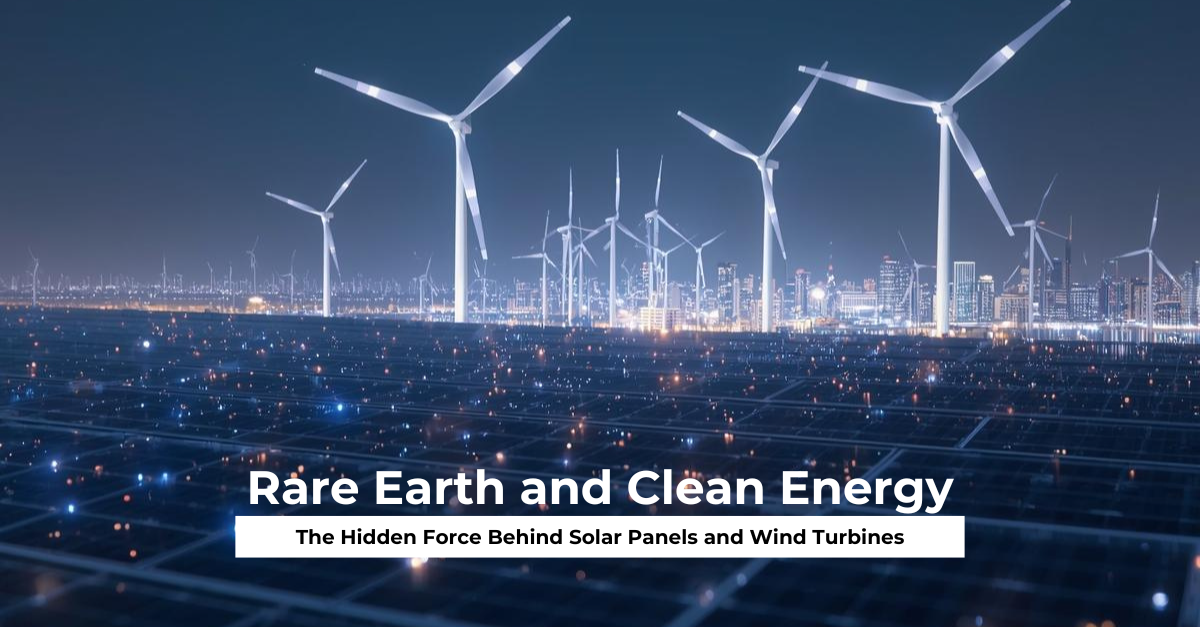
Rare Earth and Clean Energy The Hidden Force Behind Solar Panels and Wind Turbines
Lorem ipsum dolor sit amet, consectetur adipiscing elit. Ut elit tellus, luctus nec ullamcorper mattis, pulvinar dapibus leo.Clean energy looks simple on the surface.
Sunlight hits a panel.
Wind spins a turbine.
Electricity flows quietly into our homes.
But beneath that clean and elegant image lies a complex material story.
At the center of that story is Rare Earth.
Without it, the clean energy transition would slow to a crawl.
This is the side of renewable energy few people talk about.
The Silent Materials Powering the Clean Energy Era
Why Clean Energy Is More Than Just Sun and Wind
Solar and wind are free.
The materials needed to capture them are not.
Every clean energy system depends on advanced materials.
Rare Earth makes modern renewable technology efficient.
It turns weak motion into powerful electricity.
It allows systems to be smaller, lighter, and stronger.
Materials as the Real Backbone of Energy Transition
Energy transitions are not only about fuels.
They are about materials.
Copper, lithium, cobalt, and Rare Earth all matter.
Among them, Rare Earth plays a unique role.
It improves performance rather than simply enabling function.
What Rare Earth Really Is in the Context of Clean Energy
Rare Earth Elements Used in Renewable Technologies
Not all Rare Earth elements are used equally.
Neodymium and Dysprosium are especially important.
They create powerful permanent magnets.
These magnets are the heart of wind turbines and electric generators.
Without them, efficiency drops sharply.
Why These Elements Matter More Than People Realize
Rare Earth allows energy systems to do more with less.
Less material.
Less maintenance.
Less energy loss.
That efficiency is what makes clean energy scalable.
Rare Earth Inside Solar Panels
How Solar Panels Actually Work
Solar panels convert sunlight into electricity.
They rely on semiconductors and conductive layers.
Precision matters at every step.
Rare Earth elements improve light conversion efficiency.
They help manage heat and electrical flow.
Rare Earth in Solar Cell Efficiency
Rare Earth is used in polishing and coating processes.
It improves the purity of silicon wafers.
That purity directly affects performance.
Higher efficiency means fewer panels are needed.
That lowers land use and cost.
Thin-Film vs Silicon Panels
Thin-film panels use Rare Earth differently.
They require specialized materials for stability.
Both technologies depend on Rare Earth in subtle ways.
The Role of Rare Earth in Wind Turbines
Permanent Magnets Explained
Modern wind turbines use permanent magnet generators.
These magnets are incredibly strong for their size.
Rare Earth makes that possible.
Without Rare Earth, turbines would be heavier.
Maintenance costs would rise.
Why Modern Wind Turbines Depend on Rare Earth
Permanent magnets improve reliability.
They reduce mechanical complexity.
This is crucial for offshore wind farms.
Maintenance at sea is expensive.
Efficiency matters more than ever.
Offshore Wind and High-Performance Magnets
Offshore turbines face harsh conditions.
Rare Earth magnets maintain performance under stress.
They are built for endurance.
Why Clean Energy Needs Powerful Magnets
Strength, Stability, and Efficiency
Rare Earth magnets are small but mighty.
They maintain magnetic strength over time.
That stability keeps systems reliable.
Why Alternatives Fall Short
Other magnets exist.
But they are weaker or bulkier.
That limits design flexibility.
Clean energy needs compact power.
Rare Earth and Energy Storage Systems
Batteries Beyond Lithium
Energy storage is not just about lithium.
Rare Earth improves battery management systems.
It supports thermal control and efficiency.
Grid-Scale Energy Storage
Large energy grids need stability.
Rare Earth helps regulate power flow.
This keeps renewable energy reliable.
The Global Supply Chain Behind Clean Energy Materials
Where Rare Earth Comes From
Rare Earth production is concentrated.
China dominates mining and processing.
This creates supply risks for clean energy projects.
Processing and Refining Bottlenecks
Mining is only the first step.
Refining is more complex.
Few countries have this capability.
Supply Chain Concentration Risks
Disruptions can delay clean energy projects.
Material security is now energy security.
Environmental Trade-Offs of Green Energy Materials
Mining Impacts vs Climate Benefits
Rare Earth mining can harm ecosystems.
But clean energy reduces carbon emissions.
This creates a difficult trade-off.
The Environmental Paradox of Clean Energy
Green energy is not impact-free.
It shifts environmental pressure upstream.
Responsible sourcing becomes critical.
Rare Earth Recycling and Renewable Energy Waste
End-of-Life Solar Panels and Turbines
Renewable infrastructure has a lifespan.
Recycling will become essential.
Rare Earth recovery is challenging but promising.
Recycling Challenges and Opportunities
Separation is technically complex.
But progress is accelerating.
Can Clean Energy Scale Without Rare Earth?
Scientific Research on Substitutes
Researchers are exploring alternatives.
So far, performance falls short.
Why Replacement Is Not Easy
Rare Earth properties are unique.
Nature does not offer easy substitutes.
Rare Earth and the Race to Net Zero
Material Constraints on Climate Goals
Climate targets depend on materials.
Rare Earth shortages could slow progress.
The Timeline Problem
Demand is rising faster than supply.
This gap must be addressed.
Innovation and Technology Breakthroughs
Cleaner Mining Technologies
New methods reduce waste and emissions.
Sustainability is improving gradually.
Magnet Efficiency Improvements
Better design reduces material use.
Innovation eases pressure on supply.
Why Rare Earth Will Define the Clean Energy Transition
The Invisible Foundation of Green Power
Rare Earth rarely appears in headlines.
Yet it holds clean energy together.
The transition depends on it.
Clean Energy Runs on Rare Earth
Clean energy is not just about nature.
It is about materials, technology, and balance.
Rare Earth sits quietly at the center.
Understanding this connection helps build a smarter transition.
A cleaner future depends on responsible use of Rare Earth.
Frequently Asked Questions
Why is Rare Earth important for wind turbines?
Because it enables powerful, efficient permanent magnets.
Do solar panels really use Rare Earth?
Yes, especially in manufacturing and efficiency improvements.
Is clean energy truly sustainable if Rare Earth mining pollutes?
It can be, with stricter standards and better technology.
Can recycling solve Rare Earth shortages?
It helps, but cannot replace mining yet.
Will clean energy slow down without Rare Earth?
Yes, efficiency and scalability would suffer significantly.