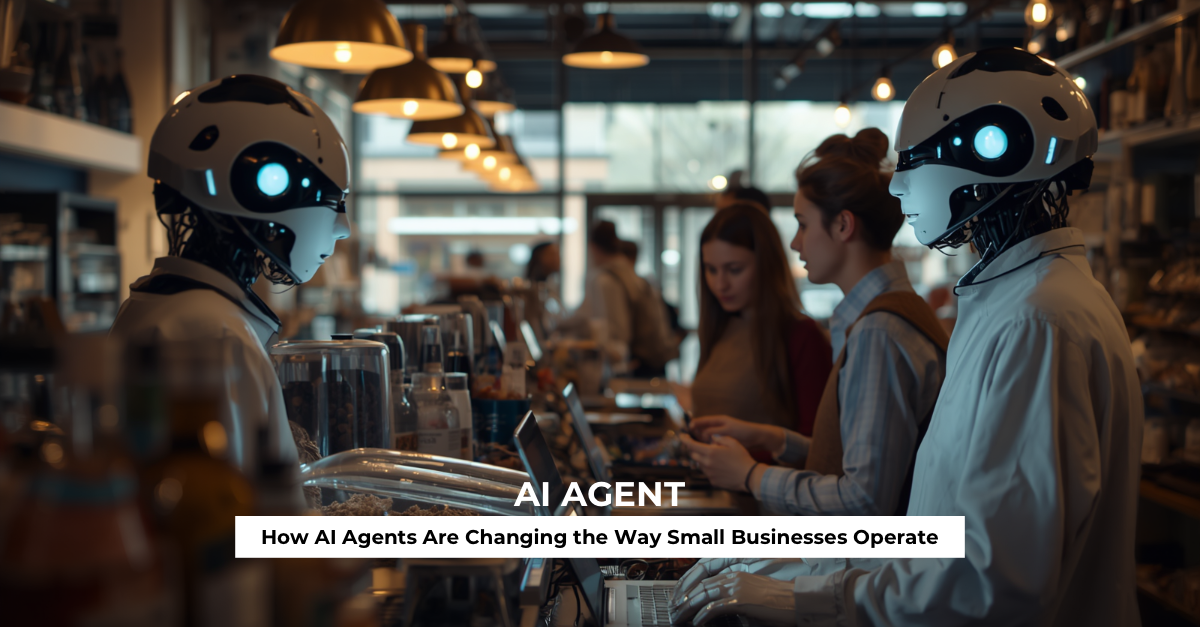
How AI Agents Are Changing Small Business Operations
A few years ago, “using AI” at a small business usually meant one person pasting text into a chatbot to draft an email faster. That’s not what’s happening anymore. Across small companies — plumbing outfits, boutique law practices, e-commerce shops, dental clinics — a quieter shift is underway. Software that used to just answer questions is starting to do things: booking appointments, chasing unpaid invoices, answering customer emails end-to-end, updating inventory, and flagging problems before a human ever notices them.
That software is generally called an AI agent, and the distinction between an agent and a chatbot matters more than most marketing pages let on. This article breaks down what AI agents actually are, where they’re already changing how small businesses run day to day, what the honest tradeoffs look like, and how to start without wasting money or trust.
1. What Is an AI Agent, Really?
A chatbot answers. An AI agent acts.
A chatbot waits for a prompt, generates a response, and stops. An AI agent, by contrast, is built to take a goal — “follow up with every customer who hasn’t paid their invoice in 30 days” — and independently break that goal into steps, decide what tools or software to use, execute those steps, and adjust if something doesn’t go as planned. It can check a database, send an email, wait for a reply, update a spreadsheet, and escalate to a human only when it hits something it can’t resolve.
That difference — planning and executing a multi-step task with minimal supervision — is what separates “generative AI” from “agentic AI.” Generative AI produces content in response to prompts. Agentic AI uses similar underlying models but adds the ability to reason across steps, call external tools, and carry out a task with a defined outcome rather than a single reply.
For a small business, this means the software isn’t just a faster typist. It’s closer to a junior employee who never sleeps, never forgets a step, and can be duplicated instantly across every customer interaction.
2. Why Small Businesses Are Adopting AI Agents Faster Than Expected
Adoption of AI tools among small businesses has moved unusually fast compared with past technology shifts. Multiple industry surveys report that regular AI usage among small and midsize businesses climbed sharply between 2024 and 2026 — several trackers put it in the range of roughly 48% to over 75% of small firms using AI regularly, depending on how “regular use” is defined. That range is wide because researchers measure adoption differently, but the direction is consistent: usage is rising quickly and shows no sign of plateauing.
A few forces are driving that speed:
• Cost has collapsed. Capabilities that once required a custom engineering team are now available through subscriptions costing a few dollars to a few hundred dollars per month.
• No-code tools removed the technical barrier. Business owners can now connect an AI agent to their email, calendar, or CRM without writing code.
• Labor costs and hiring difficulty pushed owners to look for alternatives. Many small businesses can’t easily hire a part-time admin assistant, but they can afford a $20–$50/month tool that handles similar tasks.
• Early adopters are pulling ahead. Multiple surveys report that small businesses actively using AI are meaningfully more likely to report revenue growth than those that aren’t, which creates competitive pressure on the businesses still sitting on the sidelines.
It’s worth being clear-eyed here too: most small businesses using AI are still in an early or experimental stage. Only a small share have reached what researchers call “advanced” adoption, where AI is embedded into core operations with a clear strategy behind it. The gap between trying a tool and actually depending on it is still large for most small companies.
3. Where AI Agents Are Making the Biggest Difference
Not every part of a small business benefits equally. The clearest wins tend to cluster around repetitive, rules-based, high-volume tasks — the kind of work that eats hours but doesn’t require deep judgment every time.
Customer service and support. AI agents can handle first-contact questions, look up order status, process simple returns, and escalate genuinely complex issues to a human. Adoption of AI in customer service has grown quickly as chatbot and agent quality has improved, and this remains one of the most common entry points for small businesses trying agents for the first time.
Scheduling and appointment management. Service businesses — salons, clinics, contractors — are using agents to handle booking, rescheduling, and reminder follow-ups without a front-desk employee manually managing a calendar all day.
Marketing and content operations. Marketing content creation is consistently cited as one of the top AI use cases among small businesses, from drafting social posts to managing multi-channel campaigns with minimal manual oversight.
Bookkeeping and financial admin. Agents connected to accounting software can categorize expenses, flag anomalies, and chase overdue invoices automatically.
Inventory and order management. E-commerce sellers use agents to monitor stock levels, reorder from suppliers, and update product listings across multiple sales channels.
4. Real-World Examples by Department
Sales: An agent monitors incoming leads from a website form, qualifies them against a simple checklist, sends a personalized first response within minutes, and only hands off to a salesperson once a lead meets defined criteria.
Customer support: A boutique retailer connects an agent to its help desk inbox. It resolves shipping questions and simple exchanges on its own, and drafts a suggested reply for anything involving a complaint, which a human reviews before sending.
Operations: A small logistics company uses an agent to watch delivery tracking data and proactively message customers when a shipment is delayed, instead of waiting for a complaint.
HR and hiring: A growing team uses an agent to screen resumes against a job description, schedule first-round interviews, and send rejection or next-step emails automatically.
Finance: An agent reviews incoming invoices, matches them against purchase orders, and only surfaces exceptions — mismatches or unusually large charges — for a human to approve.
In each case, the pattern is the same: the agent handles the predictable 80% of the workflow, and a person handles the judgment-heavy 20%.
5. Benefits Small Businesses Are Reporting
Time savings. Multiple industry surveys report small business owners and managers saving in the range of five to seven-plus hours per week after integrating AI tools into daily workflows — time that would otherwise go to manual admin work.
Revenue impact. A large share of small businesses using AI — reported at over 90% in some industry surveys — say it has contributed to measurable revenue growth, largely through faster response times, broader marketing reach, and reduced missed opportunities.
Lower cost than hiring. For many owners, an AI agent subscription costs a fraction of what a part-time employee or outside agency would charge for comparable output, particularly in marketing and customer support.
Faster response times. Because agents work continuously, customers get replies outside business hours, which matters more than ever now that people expect near-instant answers online.
Operational consistency. Unlike a rotating cast of part-time staff, an agent follows the same process every time, which reduces the “it depends who answered the phone” problem many small businesses struggle with.
6. The Honest Drawbacks and Risks
No credible article on this topic should pretend AI agents are risk-free. They aren’t.
Inconsistent results without setup discipline. A large share of small businesses using AI have no formal process or prompting strategy in place, which leads to inconsistent, sometimes embarrassing outputs — an agent that emails a customer with the wrong tone, or misreads a request.
Low measured ROI industry-wide. Broader research on AI initiatives across businesses of all sizes has found that a striking share of AI projects fail to show measurable return, often because the tool was deployed without training or a clear use case, not because the technology itself doesn’t work.
Data privacy and security exposure. Connecting an agent to customer data, payment systems, or email accounts increases the attack surface. Small businesses often lack the IT resources to properly vet a tool’s security practices before granting it access.
Over-trust in autonomous decisions. An agent that’s given too much authority — say, the ability to issue refunds without limits — can make costly mistakes at a speed no human employee could match.
Customer trust concerns. Some customers still prefer knowing they’re speaking to a human, particularly for sensitive issues like billing disputes or complaints. Businesses that don’t disclose AI involvement risk damaging trust if customers feel misled.
Skill and training gaps. Only a minority of small businesses using AI report having received any formal training, which means most usage is still trial-and-error rather than a deliberate, monitored process.
7. AI Agent vs. Chatbot vs. Traditional Automation
Traditional automation (like an if-this-then-that workflow tool) follows rigid, pre-programmed rules. It’s reliable but can’t handle anything outside its exact instructions.
A chatbot uses AI to generate a conversational response but generally doesn’t take independent action beyond replying in the conversation.
An AI agent combines reasoning with the ability to act — it can call other software, make decisions based on context, and complete a multi-step task toward a goal, adjusting along the way.
Think of it as a ladder: traditional automation is a light switch, a chatbot is a knowledgeable receptionist who can only talk, and an AI agent is closer to a junior staff member who can actually pick up the task and carry it through to completion — with defined limits on what they’re allowed to decide alone.
8. How to Choose the Right AI Agent for Your Business
Start with the workflow, not the tool. Pick one specific, repetitive, time-consuming task — not “improve customer service” broadly, but “handle first-response emails for order status questions.”
Match the tool to your existing software. An agent that doesn’t integrate cleanly with your calendar, CRM, or accounting software will create more manual work, not less.
Check the escalation logic. A good agent should clearly hand off to a human when it’s uncertain, rather than guessing.
Ask about data handling. Understand exactly what customer or financial data the tool can access, where it’s stored, and whether it’s used to train other models.
Look for a trial period. Never commit to a long-term contract before testing the tool against your real workflow for at least two to four weeks.
Weigh cost against realistic time savings. A tool that costs $50/month and saves three hours a week is a clear win for most small businesses; a tool that costs $500/month and saves the same three hours usually isn’t, unless it’s also driving measurable revenue.
9. A Realistic 90-Day Implementation Plan
Days 1–14: Pick one workflow. Choose a single, well-defined, repetitive task. Document exactly how a human currently does it, step by step, before automating anything.
Days 15–30: Run in “shadow mode.” Let the agent draft responses or actions, but have a human review and approve everything before it goes live. This surfaces mistakes before customers ever see them.
Days 31–60: Go live with limits. Give the agent authority over low-risk actions only (drafting replies, scheduling, flagging), while keeping higher-risk actions (refunds, cancellations, legal language) with a human.
Days 61–90: Measure and expand — or roll back. Track time saved, error rate, and customer feedback. If the numbers hold up, expand the agent’s scope carefully. If they don’t, scale back before expanding further rather than doubling down on a broken process.
10. Common Mistakes Small Businesses Make
• Automating a broken process. An agent will execute a messy workflow faster, not fix it.
• Giving too much autonomy too soon. Full authority on day one, with no review period, is how expensive mistakes happen.
• Skipping training entirely. Most underperforming AI deployments trace back to a lack of setup, not a lack of capability in the tool itself.
• Choosing tools based on hype rather than fit. The most-talked-about tool isn’t always the one that integrates with your specific software stack.
• Not telling customers. Being transparent that an AI agent is involved, especially for support interactions, tends to preserve trust better than pretending it’s a person.
11. Common Myths About AI Agents
Myth: AI agents will replace most small business employees. In practice, the clearest wins come from agents handling the repetitive slice of a job so humans can focus on the judgment-heavy parts — not full replacement.
Myth: AI agents work well right out of the box. Most need a defined workflow, a review period, and ongoing adjustment to perform reliably.
Myth: Bigger, more expensive tools always perform better. Fit with your existing workflow and software matters more than brand recognition or price.
Myth: AI agents are only for tech companies. Some of the fastest adoption is happening in traditionally low-tech service industries — home services, healthcare practices, retail — because the manual workload there is so high.
12. The Future of AI Agents in Small Business
Analysts tracking enterprise software expect the share of business applications that include task-specific AI agents to rise substantially through the rest of this decade, moving from a small minority of tools today toward a much larger share within a few years. For small businesses, that likely means the AI agent won’t be a separate product they have to shop for — it’ll increasingly be a built-in feature of the accounting software, CRM, and scheduling tools they already use.
Expect three shifts over the next few years:
1. Agents will get better at knowing their limits — escalating to humans more intelligently instead of guessing.
2. Multi-agent systems will become more common, where several specialized agents (one for support, one for scheduling, one for finance) work together rather than one general-purpose tool trying to do everything.
3. Regulation and disclosure requirements will tighten, particularly around AI interacting directly with customers, which will push businesses toward more transparent AI use rather than less.
13. Expert Insights and Industry Standards
Analysts broadly agree on one point: the businesses seeing the strongest results from AI agents are not the ones spending the most money — they’re the ones matching a specific tool to a specific, well-understood workflow and training their team to use it properly. Multiple industry sources report that structured training produces meaningfully better outcomes than deploying a tool without it.
Reputable frameworks for evaluating AI tools generally recommend assessing data governance, human oversight, and transparency alongside raw capability — a useful checklist for any small business owner comparing vendors.
• AI agents differ from chatbots because they can plan, act, and complete multi-step tasks with minimal supervision.
• Small business adoption of AI has accelerated dramatically since 2024, though most businesses remain in early, experimental stages rather than full strategic deployment.
• The clearest wins are in customer service, scheduling, marketing, bookkeeping, and inventory management.
• Real risks exist — inconsistent output, data exposure, over-autonomy, and low measured ROI industry-wide — and they’re mostly solved with a defined workflow, a review period, and proper training.
• Start with one workflow, test in shadow mode, and expand only after measuring results.
Frequently Asked Questions
What is an AI agent in simple terms?
It’s software that can take a goal, break it into steps, use other tools or software to complete those steps, and adjust along the way — closer to a digital assistant than a search box.
Can small businesses actually afford AI agents?
Yes, in most cases. Many capable tools are available for $20–$100 per month, which is substantially less than hiring part-time help for the same tasks.
What tasks can AI agents realistically handle today?
Repetitive, well-defined tasks: first-response customer support, appointment scheduling, invoice follow-up, lead qualification, and basic inventory monitoring are the most common, proven use cases.
Are AI agents safe for handling customer data?
It depends entirely on the vendor. Ask specifically how data is stored, whether it’s used for training other models, and what security certifications the company holds before connecting an agent to sensitive systems.
Do AI agents replace employees?
Rarely in full. Most small businesses use them to absorb repetitive workload, freeing employees for higher-judgment work rather than eliminating roles outright.
AI agents aren’t a passing trend, and they aren’t magic either. They’re a genuinely new category of software that can take on real, multi-step work — and small businesses are adopting them faster than almost any other technology shift in recent memory. The businesses getting real value aren’t the ones buying the flashiest tool. They’re the ones starting with one clear workflow, testing carefully, training their team, and expanding only once the numbers back it up.
If you’re considering your first AI agent, don’t start by shopping for tools. Start by writing down the one task in your business that eats the most time for the least judgment — that’s your first candidate for automation.
#AIAgents #SmallBusinessAI #BusinessAutomation #AIforBusiness #Entrepreneurship #FutureOfWork #DigitalTransformation #SmallBusinessTips #AITools #Productivity