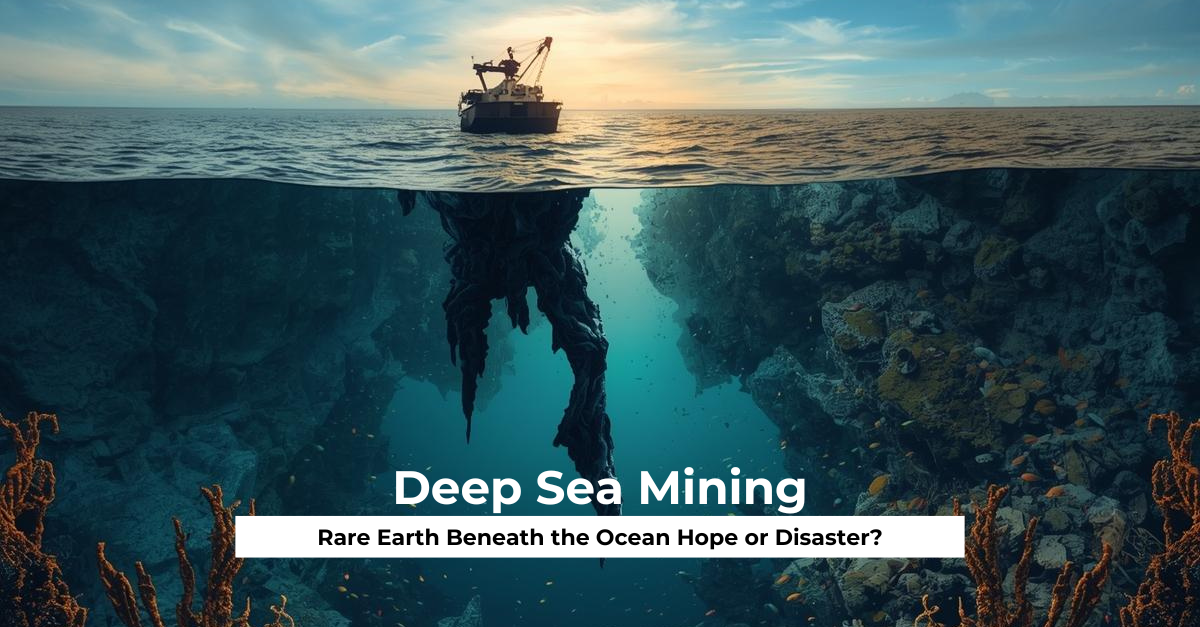
Deep Sea Mining Rare Earth Beneath the Ocean Hope or Disaster?
Lorem ipsum dolor sit amet, consectetur adipiscing elit. Ut elit tellus, luctus nec ullamcorper mattis, pulvinar dapibus leo.The ocean has always felt infinite.
Mysterious.
Untouchable.
For centuries, humans looked to land for resources.
Now, as demand for Rare Earth surges,
our attention is drifting downward—
far below the waves.
Deep sea mining promises access to hidden wealth.
But it also raises uncomfortable questions.
Is this humanity’s next great solution,
or the beginning of an irreversible mistake?
The New Frontier Below the Waves
When Land Resources Are No Longer Enough
Rare Earth demand is accelerating.
Clean energy, electric vehicles, AI, and electronics
all rely on it.
Land-based mining struggles to keep pace.
Environmental opposition grows.
Supply chains feel fragile.
The deep ocean begins to look tempting.
Why the Deep Sea Suddenly Matters
Vast areas of the seabed remain unexplored.
Scientists estimate enormous mineral deposits below.
Rare Earth-rich formations lie untouched.
What once seemed unreachable
now feels technologically possible.
What Is Deep Sea Mining in Simple Terms
Mining the Ocean Floor Explained
Deep sea mining involves extracting minerals
from the seabed, often thousands of meters deep.
Robotic machines crawl across the ocean floor.
They collect mineral-rich materials.
Pipelines lift them to surface ships.
It sounds futuristic.
Because it is.
How It Differs from Traditional Mining
There are no tunnels or open pits.
No blasting mountains apart.
Instead, the ocean floor itself becomes the site.
Out of sight.
Far from public attention.
Why Rare Earth Exists Beneath the Ocean
Geological Processes Over Millions of Years
The ocean floor is a slow factory.
Minerals accumulate drop by drop.
Metal particles bind together over time.
This process takes millions of years.
Nature works patiently.
Polymetallic Nodules, Crusts, and Sulfides
Three formations attract the most attention:
Polymetallic nodules scattered like stones
Cobalt-rich crusts on underwater mountains
Sulfide deposits near hydrothermal vents
These structures contain Rare Earth
alongside nickel, cobalt, and manganese.
Why These Materials Attract Global Attention
These minerals are essential for clean technology.
Demand rises every year.
Supply does not.
The imbalance fuels interest.
Rare Earth and the Growing Global Demand
Clean Energy, EVs, and Digital Life
Wind turbines need strong magnets.
Electric vehicles need efficient motors.
Smartphones demand precision materials.
Rare Earth sits quietly inside all of them.
Why Land-Based Supply Is Under Pressure
Mining on land faces limits.
Environmental damage.
Community resistance.
Geopolitical risk.
The ocean appears as an alternative.
The Technology Behind Deep Sea Mining
Robotic Collectors and Seabed Vehicles
Machines operate in darkness and pressure.
They must withstand extreme conditions.
Remote control replaces human presence.
This technology is impressive.
But still experimental.
Lifting Materials from Extreme Depths
Once collected, materials travel upward.
Kilometers of water separate seabed and ship.
Mechanical failure is always a risk.
Technical Risks and Engineering Limits
Pressure crushes equipment.
Salt corrodes systems.
Repairs are costly and slow.
Nature does not forgive mistakes easily.
Who Is Racing to Mine the Deep Sea
Governments, Corporations, and Startups
Countries seek material security.
Companies seek competitive advantage.
Startups promise innovation.
The race is global.
The Role of the International Seabed Authority
International Seabed Authority oversees mining beyond national waters.
It grants exploration licenses.
It sets preliminary rules.
Licenses, Exploration Zones, and Power
Dozens of zones are already claimed.
Exploration is underway.
Pressure to move fast is rising.
Potential Benefits of Deep Sea Mining
Access to Untapped Rare Earth Resources
The seabed holds vast quantities.
Enough to support decades of demand.
Reduced Dependence on Single Countries
Supply diversification matters.
Resource security matters.
Deep sea mining promises both.
Economic Opportunities for Developing Nations
Some countries see opportunity.
Licensing fees.
Technology transfer.
New revenue streams.
Environmental Risks Beneath the Surface
Destruction of Fragile Deep-Sea Ecosystems
The deep ocean is not empty.
It is alive.
Slow-growing.
Delicate.
Disturbance may destroy habitats forever.
Sediment Plumes and Ocean Pollution
Mining stirs up fine sediments.
These clouds can spread for miles.
They may suffocate marine life.
Damage That May Be Permanent
Recovery could take centuries.
Or may never happen at all.
The Biodiversity We Barely Understand
Unknown Species in the Deep Ocean
Many deep-sea species remain undiscovered.
They exist nowhere else.
Destroying habitats risks losing life
before we even name it.
Why Scientific Knowledge Is Still Limited
Research is expensive.
Exploration is slow.
Knowledge lags behind ambition.
Deep Sea Mining vs Land-Based Mining
Environmental Trade-Offs Compared
Land mining scars landscapes.
Ocean mining scars ecosystems.
Which damage is easier to repair?
That question has no easy answer.
Carbon Footprint and Resource Efficiency
Deep sea mining may reduce deforestation.
But fuel use is high.
Emissions remain significant.
Ethical Questions Around Deep Sea Mining
Who Owns the Ocean Floor?
The deep sea belongs to no one.
Or to everyone.
This ambiguity complicates responsibility.
Responsibility to Future Generations
Minerals can be used once.
Ecosystems may never recover.
That imbalance weighs heavily.
Opposition from Scientists and Environmental Groups
Calls for a Global Moratorium
Many experts urge caution.
Pause before exploitation.
Study before action.
Concerns About Rushing into the Unknown
Once damage occurs,
there is no reset button.
Supporters’ Arguments: A Necessary Evil?
Climate Goals and Material Shortages
Climate targets are ambitious.
Materials are essential.
Some argue delay risks climate failure.
Mining the Sea to Save the Planet?
This argument divides opinion sharply.
The tension is real.
Regulation, Law, and Global Governance
International Law of the Sea
Rules exist, but gaps remain.
Technology moves faster than law.
Can Rules Keep Up with Technology?
Regulation often reacts too late.
The ocean deserves better timing.
The Economic Reality of Deep Sea Mining
High Costs and Uncertain Profits
Technology is expensive.
Returns are unclear.
Investors remain cautious.
Investor Risks and Market Volatility
Mineral prices fluctuate.
Public opposition adds uncertainty.
Future Scenarios: Hope or Environmental Disaster
Responsible Innovation Path
Strong rules.
Limited extraction.
Transparent science.
This path is possible.
Worst-Case Environmental Collapse
Unchecked exploitation.
Irreversible damage.
Global regret.
This path is also possible.
Why Deep Sea Mining Forces a Global Choice
Technology vs Conservation
Progress always asks a price.
The question is how much we are willing to pay.
The Ocean Floor Holds More Than Minerals
Deep sea mining is not just a technical issue.
It is a moral crossroads.
Rare Earth beneath the ocean may fuel the future.
Or damage it beyond repair.
The decision made today
will echo for generations.
Frequently Asked Questions
What is deep sea mining in simple words?
It is the extraction of minerals from the ocean floor using advanced machines.
Why is Rare Earth found in the deep sea?
Because minerals accumulate slowly over millions of years on the seabed.
Is deep sea mining already happening?
Exploration is underway, but large-scale mining has not fully begun.
Why are scientists worried about deep sea mining?
Because deep-sea ecosystems are fragile and poorly understood.
Can deep sea mining help fight climate change?
It may supply critical materials, but environmental risks remain significant.