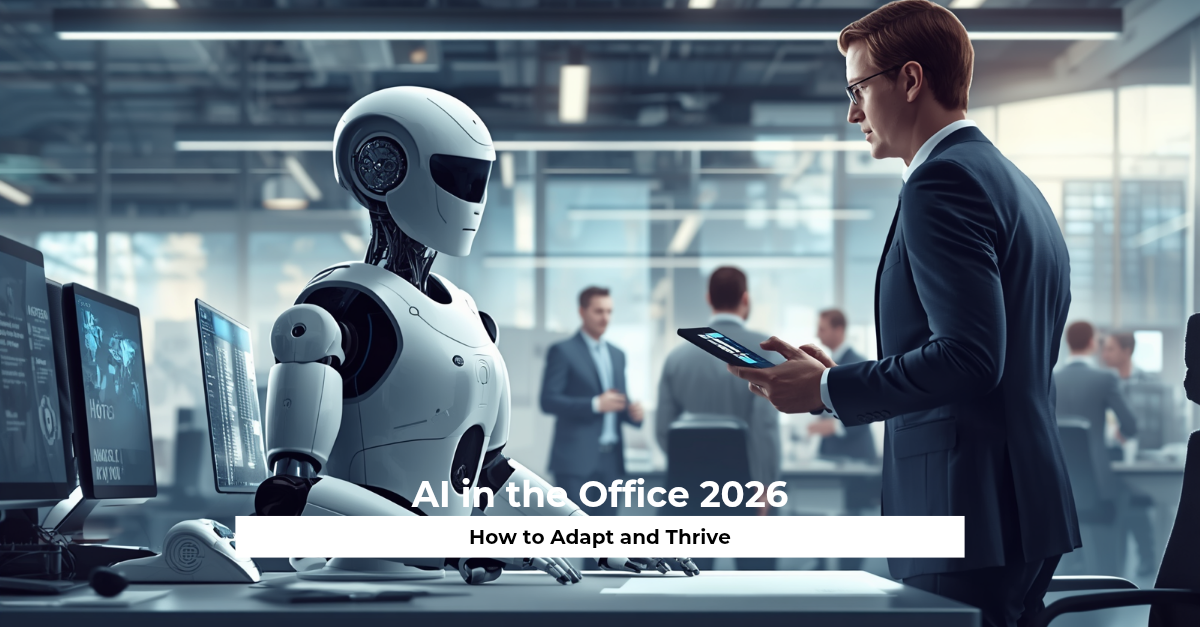
AI in the Office A 2026 Survival Guide for the Modern Workforce
Imagine walking into the office on Monday to find AI already summarized every meeting from the week before you even had coffee — this isn’t science fiction anymore. It’s happening in offices right now.
A deep dive into how AI is reshaping offices worldwide, with practical adaptation strategies for employees and organizations.
Organizations worldwide are integrating AI into daily operations — from drafting emails to summarizing reports and analyzing customer data. Unlike past technology shifts, this one is happening fast, condensed into just the past two or three years. The real question isn’t “will AI arrive,” but “how do we adapt to benefit from it most.”
How AI Is Changing the Office
1. Documentation & Communication
AI drafts emails, summarizes meetings, and compiles reports in minutes, cutting down on repetitive work significantly.
2. Data Analysis
AI tools process large datasets and surface insights that would otherwise take humans days to uncover.
3. Customer Service
Chatbots and AI systems handle basic inquiries around the clock, freeing employees to focus on complex issues.
4. Strategic Decision-Making
Executives use AI to forecast market trends and assess risk, though final decisions remain human-driven.
Essential Skills for the AI Era
Prompting skills — communicating effectively with AI has become a foundational new skill
Critical thinking — always verify AI output before acting on it
Creativity — AI generates content, but original ideas still come from humans
Emotional intelligence — work requiring empathy and negotiation remains a human strength
Adaptability — technology changes fast, so continuous learning is essential
Actionable Tips
Use an approved AI tool at least 3 times a week
Take a free AI-literacy course available on major platforms
Always fact-check AI output before submitting work
Build a portfolio showing how AI has boosted your output
Common Mistakes
Trusting AI output without verification
Viewing AI as a threat instead of a tool
Avoiding learning out of fear it’s “too late”
Over-relying on AI to the point of losing core skills
Future Trends
Many organizations are moving toward a “Human + AI” model where employees collaborate with AI agents rather than being replaced by them. New roles — AI trainers, prompt engineers, AI ethics officers — are emerging globally, while companies that adapt slowly risk losing competitiveness.
Expert Opinion
Most HR experts agree that organizations investing in “AI collaboration training” now will hold a long-term productivity edge over those that wait and see.
AI isn’t here to take jobs — it’s here to change how we work. Those who adapt quickly, learn new skills, and use AI as a productivity partner will have the strongest advantage in tomorrow’s job market.
FAQ
Will AI replace all office jobs?
Not entirely — AI replaces repetitive tasks, but work requiring judgment, creativity, and human relationships still needs people.
Do I need to learn coding to use AI well?
No — most modern AI tools are designed for natural language use, not coding.
How should small companies start using AI?
Start small — drafting emails or summarizing documents — before expanding to more complex tasks.
Start adapting today. Pick one AI tool and try it in your current work — see how much it helps. Your future in the workplace starts with this small step.
#AIatWork #FutureOfWork #WorkplaceAI #DigitalTransformation #AIskills