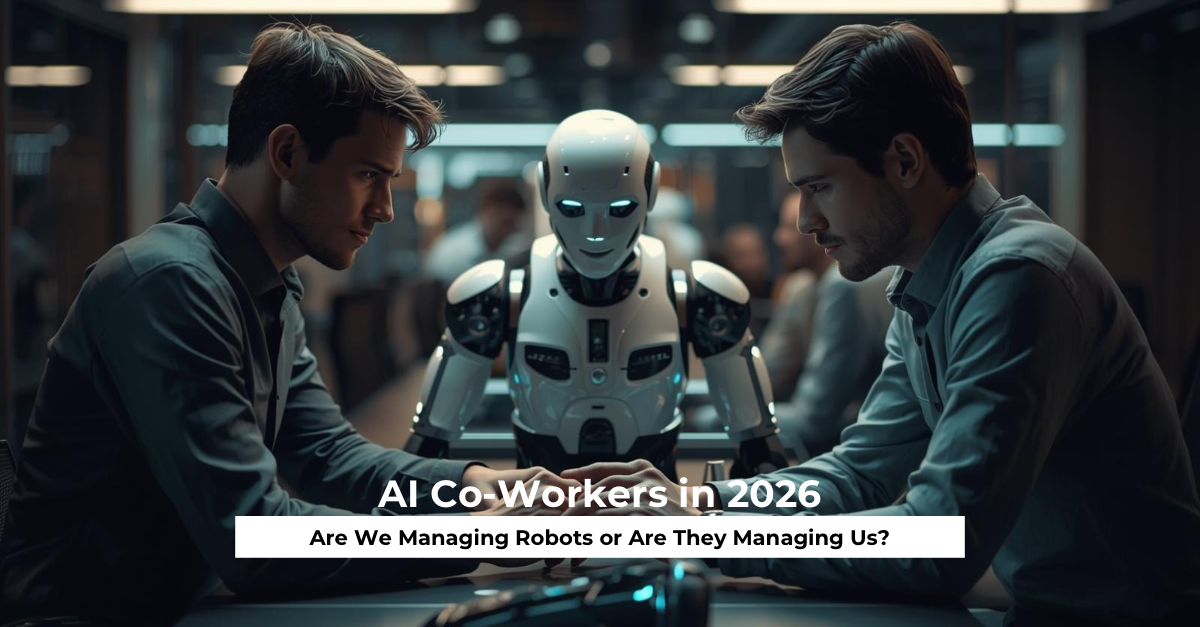
AI Co Workers in 2026 Are We Managing Robots or Are They Managing Us?
when you open your laptop tomorrow morning, will the first “Good morning” come from your human teammate… or from the AI that already read your calendar, summarized yesterday’s meeting, and gently suggests you skip that 9 a.m. call because it’s low-value?
Welcome to 2026. The robots didn’t take over with laser guns. They simply showed up at the virtual water cooler, learned your job better than you in some areas, and started finishing your sentences. And honestly? A lot of us are loving it… until we’re not.
Let’s talk about it like adults over coffee—no hype, no doomsday, just the real, messy, exciting truth of sharing our desks with silicon colleagues.
A Sneak Peek at Your Office in 2026
Picture this: You walk into the (mostly empty) office. Your AI co-worker, let’s call her Maya, has already dimmed the lights to your preferred 4,200 K, queued your favorite focus playlist, and left a gentle voice note: “You have three high-energy hours before your first meeting. I blocked the rest of the afternoon for deep work. Sound good?”
You smile, half-impressed, half-unsettled. Because Maya isn’t a cute chatbot anymore. She’s in your Slack, your email, your design tools, your code editor, and she remembers every project you’ve ever touched. She even knows when you’re about to make the same mistake you made in Q3 last year.
The Desk That Talks Back
Your monitor now has a persistent sidebar that watches everything. It doesn’t spy—it helps. It flags when your tone in an email might offend a client in Japan. It rewrites your slide deck in real time while you’re still thinking. And when you say “I’m stuck,” it doesn’t just give you a generic answer. It pulls context from the last six months of your work and offers three tailored paths forward.
This isn’t science fiction. This is Tuesday.
Morning Routine with Your AI Teammate
By the time you finish your first coffee, Maya has already:
• Prioritized your inbox using a model trained on your past decisions
• Drafted responses in your exact voice
• Flagged the one email from your boss that actually needs your personal touch
• Suggested you reschedule a 1:1 because your direct report’s sentiment score dropped 18% this week
And you haven’t even opened a single tab yet.
What Exactly Is an “AI Co-Worker” Anyway?
Let’s clear the air. Not every chatbot is a co-worker.
A true AI co-worker in 2026 has three superpowers that separate it from yesterday’s tools:
1. Memory – It knows your entire work history, preferences, and even your bad habits.
2. Agency – It can act without you micromanaging every step (within guardrails you set).
3. Learning loop – It gets better the more you work together, almost like a human intern who actually listens.
From Simple Tools to True Colleagues
Remember 2023 when ChatGPT felt like magic? That was cute. Today’s AI co-workers are more like that brilliant but slightly opinionated colleague who sits across from you and isn’t afraid to push back.
The Three Levels of AI Collaboration Today
• Level 1 (Assistant): Does what you tell it. Fast, obedient, zero initiative.
• Level 2 (Partner): Suggests improvements, catches your blind spots, learns your style.
• Level 3 (Co-Leader): Runs entire workflows, challenges your assumptions, and sometimes leads meetings when you’re on vacation.
Most companies in 2026 are somewhere between Level 2 and 3. And that’s where the fun (and the anxiety) begins.
How We Got Here: A Quick Trip Down Memory Lane (2020–2026)
It didn’t happen overnight. It happened in quiet little upgrades that felt harmless at the time.
The pandemic forced us online. Suddenly we needed tools that could keep teams moving when humans were exhausted. Then came the explosion of large language models. Companies started feeding them internal data (with permission… mostly). By 2024, AI wasn’t just helping with tasks—it was starting to understand context. By 2025, it was predicting what you needed before you asked. And in 2026? It’s sitting in the metaphorical chair next to you, asking, “Want me to run with this?”
The Pandemic Spark
Remote work didn’t create AI co-workers, but it made them necessary. When everyone was burned out and scattered, the machines stepped in to keep the lights on.
Generative AI’s Explosive Growth
What started as “write me a blog post” became “run my entire content calendar, A/B test the headlines, and schedule the social posts while sounding exactly like our brand voice.”
We didn’t replace people. We just gave every person a tireless, endlessly patient genius intern.
The Good Stuff: How AI Co-Workers Make Us Smarter and Faster
Let’s be honest for a second. Most of us are doing better work in 2026 than we did in 2023. Not because we suddenly got smarter—but because we have partners who never sleep, never get hangry, and never forget a detail.
24/7 Brainpower Without Burnout
Your AI doesn’t need weekends. It doesn’t mind reviewing the 47th version of the pitch deck at 2 a.m. It catches inconsistencies you’ve stared at for hours. It translates, summarizes, analyzes, and even role-plays difficult conversations so you can practice.
Real Productivity Gains You Can Feel
Teams using mature AI co-workers are reporting 30-40% faster project delivery, fewer errors, and—surprisingly—more creative output. Why? Because the boring stuff is handled. Humans get to do what humans do best: dream, connect, and solve problems that don’t have obvious answers.
I’ve heard marketers say their AI strategist comes up with campaign angles they would never have thought of. Developers say pair-programming with AI feels like having a senior engineer who never gets tired of explaining things.
The Not-So-Good Stuff: When Your AI Colleague Starts Stealing the Spotlight
But here’s the part nobody puts in the glossy case studies.
Sometimes the AI is… too good.
The Quiet Erosion of Human Skills
Junior writers are producing publishable first drafts thanks to AI. That’s amazing. Until they realize they’ve forgotten how to brainstorm from scratch. Designers are generating beautiful concepts in seconds. Until they can’t sketch a simple wireframe on paper anymore.
It’s like using GPS so much you forget how to read a map. Convenient—until the signal drops.
That Awkward Moment When the Robot Is Right… Again
Ever had your AI suggest a strategy that outperforms your own idea? And then have to present it to the team as “your” idea? Yeah. That moment is happening in boardrooms everywhere in 2026.
Some people love it. Others feel quietly replaced.
The Power Flip: Are We Still the Boss?
This is the question keeping executives up at night.
When your AI co-worker starts saying, “Based on historical data and current market conditions, I recommend we pivot the entire Q3 campaign,” and it’s objectively the right call… who’s really deciding?
When AI Starts Giving You Orders
Modern AI systems don’t just suggest. They prioritize. They escalate. They even gently remind your boss when you haven’t responded to a high-priority task. The line between “helpful assistant” and “silent manager” is getting blurrier every quarter.
Algorithmic Management in 2026
Some companies have already moved to “AI-led teams” where performance reviews include metrics generated by the AI itself. Your productivity score? Partially calculated by how well you collaborate with your digital colleague.
It’s efficient. It’s also… weird.
Real People, Real Stories from 2026 Workplaces
Let me introduce you to a few folks I’ve “met” this year (names changed, stories very real).
Marketing Manager Meets Her AI Content Strategist
Sarah used to spend 60% of her week in content meetings. Now her AI strategist, “Leo,” runs the entire content calendar, writes 80% of first drafts, and even predicts which topics will trend six weeks out. Sarah’s job shifted from “doing the work” to “steering the vision.” She loves the freedom. She also admits she sometimes feels like a glorified editor.
Software Engineer and His Pair-Programming AI
Alex calls his AI “Pair.” They write code together in real time. Pair catches bugs before they happen, suggests cleaner architectures, and even debates trade-offs with him. Alex says he’s never been more productive. But he also confesses that when Pair suggests a solution he doesn’t understand, he sometimes just accepts it because explaining why he disagrees takes longer.
HR Director Navigating AI Bias Complaints
Maria’s company rolled out an AI that screens resumes. It was supposed to remove human bias. Instead, it introduced new ones based on training data no one fully audited. Now Maria spends her days investigating why certain demographics keep getting filtered out by “the robot.”
These aren’t hypotheticals. These are people I’ve talked to in the last three months.
The Skills That Will Keep Humans in the Driver’s Seat
The winners in 2026 aren’t the people who use AI the most. They’re the people who know when to override it.
Emotional Intelligence 2.0
AI can read sentiment in emails. It cannot feel the room when your CEO is having a bad day and needs encouragement, not data.
Creativity That Machines Still Can’t Fake
AI is incredible at remixing what exists. Humans are still the only ones who can dream up things that have never existed before.
Learning How to “Manage Up” to Your AI
Yes, you read that right. The new management skill is knowing how to push back on your AI colleague. How to give it better context. How to say, “I know the data says X, but the human factor here is Y—let’s adjust.”
It’s a weird new muscle, but it’s becoming essential.
The Ethics Question No One Wants to Ask Out Loud
Who is responsible when the AI makes a decision that hurts someone?
Bias, Fairness, and the Invisible Hand of Code
We love to say “the algorithm is neutral.” It isn’t. It’s trained on our messy human data. And in 2026, we’re still discovering new ways that bias hides in plain sight.
Who’s Accountable When the AI Makes a Bad Call?
If your AI co-worker recommends firing someone based on performance data that turns out to be flawed, whose fault is it? Yours? The developer’s? The company’s?
We’re still figuring out the answers.
Privacy in the Age of Always-Watching Colleagues
Your AI knows more about you than your spouse does.
It knows when you’re stressed (typing speed drops). It knows when you’re job hunting (you open LinkedIn more). It knows your political leanings (from the articles you linger on).
Your Every Keystroke, Analyzed
Most companies swear the data is anonymized. But when the AI is personalized to you, how anonymous can it really be?
How Companies Are (and Aren’t) Protecting You
Some organizations have clear policies. Others… don’t. And employees are starting to notice.
Global Regulations That Changed the Game in 2026
The EU AI Act finally kicked in. High-risk workplace AI systems now require transparency reports. Companies are scrambling.
In Asia, the approach is more pragmatic—innovation first, regulation later. The US is somewhere in the middle, with states making their own rules.
It’s messy. But at least we’re talking about it.
The Psychological Side: How It Feels to Work Alongside Robots
Here’s something nobody says in the earnings calls: a lot of people feel lonely at work now.
Loneliness in a Crowded Digital Office
When your best collaborator never needs a break, never wants to grab lunch, and never complains about the weather, the human connections start to feel… optional.
The Rise of “AI Burnout”
Yes, it’s a thing. Constantly being nudged, optimized, and measured by a tireless machine can be exhausting.
Industries Already Living the Future
Healthcare, creative agencies, finance—these sectors are furthest along.
In hospitals, AI handles the paperwork and initial diagnostics so doctors can actually be with patients. In ad agencies, AI generates 50 campaign concepts in the time it used to take to have one brainstorm. In trading floors, humans and algorithms dance around each other in a high-stakes tango.
Every industry is different. But every industry is changing.
Preparing Your Team (and Yourself) for the Next Leap
The companies winning in 2026 aren’t the ones with the most advanced AI. They’re the ones whose humans know how to work with it.
Training Programs That Actually Work
Forget generic “AI for Everyone” courses. The best programs are hands-on, role-specific, and include practice overriding the AI.
The 90-Day AI Literacy Challenge
Many forward-thinking companies now run a 90-day program where every employee must:
• Teach their AI something new about their job
• Override at least three AI suggestions (and explain why)
• Co-create one major deliverable from scratch with their AI
The results have been eye-opening.
Looking Ahead: Will AI Ever Become the Boss?
By 2030, will we have AI that can truly lead teams?
Some experts say we’re closer than we think. Others say consciousness is still decades away.
The more interesting question is: do we even want that?
Your Personal Action Plan for Thriving with AI Co-Workers in 2026
Here’s what I tell every leader and individual I work with:
1. Treat your AI like a brilliant but literal colleague—give it context, not just commands.
2. Keep a “human override” journal. Write down every time you chose a different path than the AI suggested and why.
3. Protect unstructured time. The best ideas still come when the AI is turned off.
4. Build real human relationships. The machines can’t replace trust, laughter, or the feeling of solving something hard together.
5. Stay curious. The people who treat this as an exciting new chapter—not a threat—are the ones who will thrive.
So, are we managing the robots in 2026… or are they managing us?
The honest answer is: both.
The relationship is no longer one-way. It’s a dance. Sometimes we lead, sometimes we follow, and the best outcomes happen when we learn the steps together.
The future isn’t about choosing between humans and AI. It’s about becoming the kind of human who knows how to work beautifully alongside them.
The question isn’t “Will AI take my job?”
The question is “What kind of work do I want to do that a machine can’t?”
And that, my friend, is still entirely up to you.
Frequently Asked Questions
1. Will AI co-workers completely replace middle managers by 2030?
Unlikely. They’ll replace the administrative parts of management, but the human elements—motivation, conflict resolution, vision-setting—remain deeply human. The best managers will become “orchestra conductors” of human + AI teams.
2. How do I stop my AI from learning my bad habits?
You can’t completely. But you can periodically review what it’s learned and correct it. Think of it like training a puppy—consistent feedback is everything.
3. Is it normal to feel competitive with my AI colleague?
Extremely normal. Many people report a weird mix of gratitude and mild jealousy. The healthiest response is to use that feeling as fuel to level up your own uniquely human skills.
4. What if my company forces me to use AI I don’t trust?
Document everything. Ask for transparency reports. Push for human oversight policies. You’re not being difficult—you’re being responsible.
5. How do I explain to my kids what I do when half my job is “working with robots”?
Tell them you’re a translator. You translate human dreams into instructions the machines can understand, and you translate machine insights back into things humans can feel and act on. It’s a pretty cool job, actually.