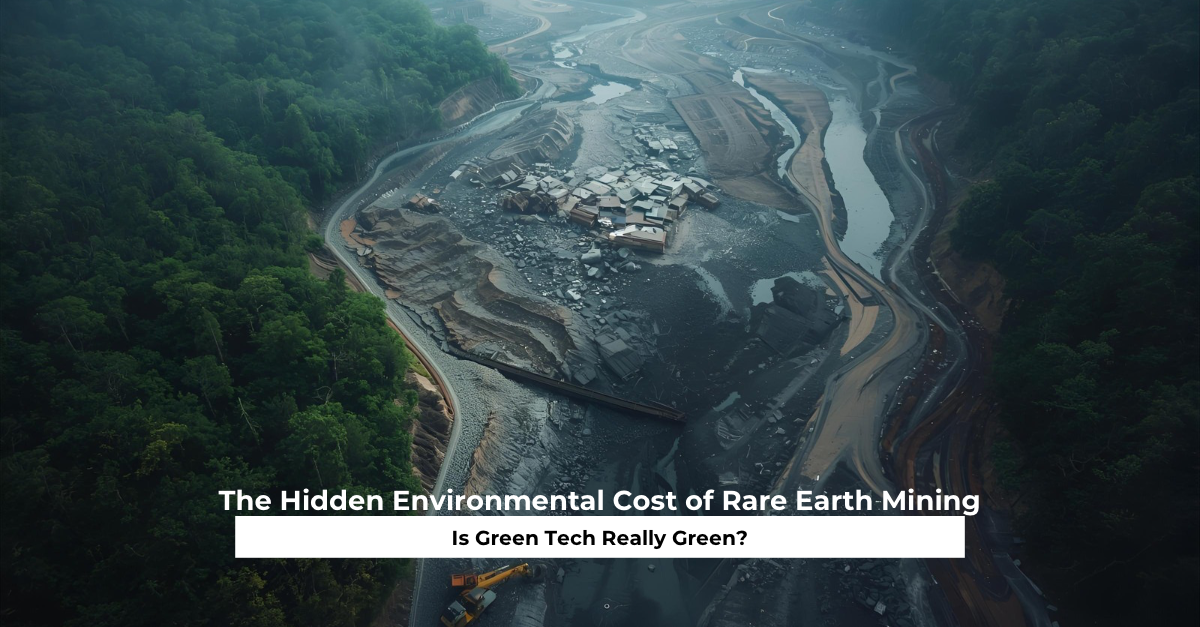
The Hidden Environmental Cost of Rare Earth Mining Is Green Tech Really Green?
The Green Tech Paradox
When we hear “green technology,” most of us picture clean energy, blue skies, and a future where pollution is finally under control. We think of sleek electric vehicles, quiet wind turbines on the horizon, and shiny solar panels soaking up sunlight. It feels like progress. It feels… clean.
But there’s a hidden side to this story that rarely appears in glossy ads or policy speeches: the environmental cost of the minerals that make all this possible—especially rare earth elements.
Behind every powerful EV motor, every high-efficiency wind turbine, and many other “green” devices, there is a chain of extraction, processing, and waste. That chain often starts with rare earth mining, and the reality on the ground can look very different from the “green” image we like to imagine.
In this article, we’ll walk through that reality together. We’ll look at what rare earths are, why they’re so important, how they’re mined, and—most importantly—what kinds of environmental and social costs are involved. Then we’ll ask the big question:
If green technologies depend on dirty mining, can we still call them truly “green”?
Let’s unpack this paradox step by step.
Why Rare Earths Matter in Modern Technology
Rare earth elements are like the quiet geniuses of modern technology. You don’t see them, you don’t hear about them very often, but your daily life relies on them in a big way.
They are crucial for:
- Powerful permanent magnets in electric motors and wind turbines
- Phosphors in LED lights and screens
- Batteries and energy storage (in some chemistries and additives)
- Catalysts in industrial processes and fuel refining
- High-tech defense systems, smartphones, and electronics
Without rare earths, our phones would be less efficient, our motors weaker, and our “green” tech solutions… much less green and effective.
The Promise vs. the Hidden Price of “Green”
On the surface, green technologies are about reducing carbon emissions and slowing climate change. And they do help—dramatically in many cases. Electric vehicles emit less CO₂ over their lifetime than gasoline cars; wind and solar generate electricity without burning fossil fuels.
But emissions are not the whole story.
To build this green future, we need a massive amount of materials: lithium, cobalt, nickel, copper—and, of course, rare earths. Mining and processing these materials consume energy, water, and chemicals, and they create waste and pollution.
So we’re faced with a tough truth:
- Yes, green technologies reduce greenhouse gas emissions over their lifetime.
- But the front end of the supply chain—mining and processing—can be very dirty.
The question isn’t “Green tech or no green tech?” We need cleaner energy. The real question is:
How do we make both the technologies and their supply chains truly sustainable?
To answer that, we need to understand rare earths from the ground up.
What Are Rare Earth Minerals, Really?
The Rare Earth Element Family Explained
“Rare earths” are a group of 17 chemical elements in the periodic table:
- The 15 lanthanides (from lanthanum to lutetium)
- Plus scandium and yttrium, which are often found in similar ores and have similar properties
They include names like:
- Neodymium (Nd)
- Praseodymium (Pr)
- Dysprosium (Dy)
- Terbium (Tb)
- Europium (Eu)
These elements have special magnetic, optical, and electronic properties. That’s why they’re used in high-performance magnets, screens, and other advanced technologies.
Key Rare Earths Used in Green Technologies
Some rare earths are especially important for “green” applications:
- Neodymium and praseodymium (Nd, Pr)
- Used in powerful NdFeB permanent magnets for EV motors and wind turbines
- Dysprosium and terbium (Dy, Tb)
- Added to magnets to maintain performance at high temperatures
- Europium, yttrium, terbium (Eu, Y, Tb)
- Used in phosphors for LED lights and displays
- Lanthanum and cerium (La, Ce)
- Used in catalytic converters, glass polishing, and some battery technologies
You may never see these names printed on your car or your laptop, but they’re there—quietly doing the heavy lifting.
Why They Are Called “Rare” (Even When They’re Not That Rare)
The term “rare earth” can be misleading. Most of these elements are actually relatively common in the Earth’s crust—some are more abundant than lead.
So why “rare”?
- They are rarely found in high concentrations that are easy and cheap to mine.
- They are often mixed together with other elements and with radioactive elements like thorium and uranium.
- Separating them into pure, usable forms is technically complex, energy-intensive, and often polluting.
So “rare” isn’t about quantity; it’s about economically viable, environmentally safe access. And that’s where the problems begin.
Where Rare Earths Come From – Global Mining Hotspots
Major Producer Countries and Regions
Most rare earths come from a small number of countries. Historically and currently, major producers include:
- China – For decades, the dominant global supplier of mined and processed rare earths
- United States – A smaller but important producer, with some efforts to revive domestic supply
- Australia – A growing producer focused on diversifying supply
- Other regions – Including parts of Southeast Asia, Africa, and South America
This concentration creates geopolitical risks and supply vulnerabilities. If one major producer faces political tension, trade restrictions, or environmental crackdowns, global supply chains can be disrupted.
From Ore to Oxide – The Basic Extraction Process
The journey from rock to refined rare earth oxide typically involves:
- Mining the ore
- Usually through open-pit mining: huge amounts of rock are dug out.
- Crushing and grinding
- The ore is broken down into smaller particles.
- Physical separation
- Methods like flotation separate rare earth-bearing minerals from waste rock.
- Chemical processing (leaching)
- Chemicals (acids, bases, organic solvents) are used to dissolve and extract the rare earths.
- Separation and purification
- Complex solvent extraction steps separate different rare earth elements from each other.
- Conversion to oxides or metals
- The purified elements are transformed into oxides, metals, or alloys used in products.
Each of these steps has environmental implications: waste rock, tailings, contaminated water, chemical residues, and energy use.
Supply Chain Concentration and Its Risks
Because processing rare earths is technically demanding and expensive, many countries have historically outsourced the dirtiest parts of the supply chain to regions with:
- Lower environmental standards
- Cheaper labor
- Less strict enforcement
This has created “sacrifice zones” where local environments and communities pay the price so the rest of the world can enjoy green technologies.
The Environmental Footprint of Rare Earth Mining
Land Degradation and Habitat Loss
Open-Pit Mines and Landscape Scars
Rare earth mining is often done through open-pit mining, which:
- Removes the topsoil and vegetation
- Creates huge pits and waste rock piles
- Disrupts natural drainage patterns
From above, these mines look like deep craters or giant wounds in the landscape. Once the topsoil and vegetation are removed, it’s very difficult—and expensive—to restore the area to its previous state.
Impacts on Biodiversity and Local Ecosystems
When forests, wetlands, or grasslands are cleared for mining:
- Wildlife loses habitat and may be forced to migrate or face population decline.
- Soil erosion increases, especially in rainy climates.
- Sediment runoff can choke rivers and streams, affecting fish and other aquatic life.
In some regions, mining takes place in or near biodiversity-rich areas, amplifying the ecological damage.
Water Use, Contamination, and Toxic Waste
Rare earth mining and processing can be water-intensive, and the water that leaves the site is often polluted.
Acidic Wastewater and Heavy Metal Pollution
In the extraction process, large volumes of water are used for:
- Washing ore
- Leaching out rare earths with acids
- Transporting slurry mixtures
The wastewater can contain:
- Acids and bases
- Heavy metals like lead, cadmium, arsenic
- Radioactive elements such as thorium and uranium
- Organic solvents used in chemical separation
If this water is not properly treated, it can pollute:
- Rivers and streams
- Groundwater
- Lakes and reservoirs
Once heavy metals and radioactive materials enter a water system, they can remain there for decades, accumulating in sediments and entering the food chain.
Impact on Local Communities and Agriculture
For communities living near rare earth mines and processing plants, contaminated water is not an abstract environmental issue; it’s a direct threat.
It can lead to:
- Unsafe drinking water
- Reduced crop yields
- Livestock health problems
- Long-term health issues in humans
Farmers may see their fields become less productive. Fishers may find that fish stocks decline or become unsafe to eat. These impacts can last long after the mine closes.
Air Pollution and Greenhouse Gas Emissions
Dust, Emissions, and Health Risks
Mining generates large amounts of dust and particulate matter:
- Blasting and drilling release dust into the air.
- Trucks and machinery add exhaust emissions.
- Processing plants can emit fumes from chemicals and high-temperature operations.
People living nearby may experience higher rates of:
- Respiratory illnesses (e.g., asthma, bronchitis)
- Eye and skin irritation
- General discomfort and reduced quality of life
Carbon Footprint Across the Mining Lifecycle
Even though rare earths are used in low-carbon technologies, their production is far from carbon-neutral. Emissions come from:
- Diesel-powered mining equipment
- Electricity use in processing plants (often from fossil fuels)
- Chemical production and transportation
- Long-distance shipping of ores and refined materials
When we celebrate a “zero-emission” car, we often forget the emissions embedded in:
- Mining its raw materials
- Processing and refining them
- Manufacturing the car and battery
To be fair, EVs and renewable energy still generally have lower life-cycle emissions than fossil fuel-based alternatives. But recognizing the carbon footprint of rare earth mining helps us see where we still need to improve.
The Radioactive Problem: Thorium, Uranium, and Toxic Tailings
Why Rare Earth Ores Often Contain Radioactive Elements
Many rare earth deposits occur together with naturally radioactive elements like:
- Thorium
- Uranium
During mining and processing, these elements can end up in the waste streams—particularly in the tailings, which are the leftovers after valuable minerals are extracted.
Tailings Ponds and Long-Term Environmental Risks
Tailings are often stored in large ponds or dams. These can contain:
- Radioactive materials
- Heavy metals
- Chemical residues
Risks include:
- Leakage into soil and groundwater
- Dam failures, which can release huge volumes of contaminated slurry
- Long-term radiation exposure for nearby communities and ecosystems
Unlike some other pollutants, radioactive contamination can remain dangerous for hundreds to thousands of years. That means today’s mining decisions can create problems for generations.
Case Studies of Contamination and Community Impact
In several countries, communities living near rare earth mining and processing sites have reported:
- Increased rates of certain cancers
- Birth defects and serious health issues
- Loss of farmland and livelihoods due to contamination
While each case is complex and influenced by many factors, the pattern is clear: when environmental controls are weak or poorly enforced, people and ecosystems pay a high price.
Social and Human Costs Behind the Minerals
Health Risks for Mine Workers and Nearby Residents
Mine workers and plant operators can be exposed to:
- Dust and fine particulates
- Chemical vapors
- Radioactive materials
Without proper protective equipment, ventilation, and health monitoring, this can lead to:
- Lung disease
- Skin and eye problems
- Higher cancer risks over time
Nearby residents can also face health risks from:
- Polluted air and water
- Contaminated soil and food
- Noise and constant dust
Environmental Injustice and Sacrifice Zones
Rare earth mining often takes place in:
- Rural areas
- Communities with lower income
- Regions with weaker political influence
These communities may have less power to resist polluting projects or demand higher standards. In many cases, they become “sacrifice zones” where:
- Environmental damage is concentrated
- Benefits (like green tech products and cleaner cities) are enjoyed elsewhere
This raises serious issues of environmental justice:
- Who suffers so that others can have clean energy and modern gadgets?
- Are we simply shifting pollution from rich, urban consumers to poor, rural communities?
Informal and Illegal Mining: The Dark Side of Demand
As demand for rare earths and other critical minerals grows, informal and illegal mining can increase.
These operations often:
- Ignore environmental regulations
- Use unsafe methods
- Exploit workers, including children in some regions
- Operate without transparency or accountability
The result is even more environmental damage and human suffering, hidden in the shadows of the green transition.
Are Green Technologies Really Green? Life Cycle Thinking
Electric Vehicles (EVs) and Rare Earth Magnets
EVs are often held up as the symbol of clean transportation—and for good reason. Over their lifetime, they typically emit significantly less CO₂ than conventional cars, especially when charged with clean electricity.
But behind that quiet motor, you may find:
- Neodymium, praseodymium, dysprosium in permanent magnets
- Other critical minerals like lithium, cobalt, nickel, copper
The mining and production of these materials:
- Use energy and water
- Generate pollution, including toxic waste and greenhouse gases
- Can harm local communities if not managed responsibly
So, is an EV “bad” for the environment? Not exactly. But it is not impact-free. It’s part of a complex system where some impacts are reduced (exhaust emissions), and others are shifted upstream (mining and manufacturing).
Wind Turbines, Solar Panels, and Energy Storage
Wind turbines often use rare earth magnets in their generators to:
- Improve efficiency
- Reduce maintenance needs
Solar panels use fewer rare earths, but they rely on other critical minerals and involve energy-intensive manufacturing.
Energy storage systems—batteries for EVs and grid storage—require various metals, some of which have their own environmental and social issues.
So even as we move away from fossil fuels, we are intensifying our demand for minerals, including rare earths.
Balancing Emission Reductions vs. Extraction Impacts
From a climate perspective, the shift to renewables and EVs is necessary. But if we focus only on CO₂ numbers and ignore the extraction side, we risk:
- Creating new environmental crises
- Deepening social injustice
- Undermining public trust in the “green transition”
We need a more complete picture—one that considers both the benefits of lower emissions and the costs of material extraction.
Life Cycle Assessment (LCA): Looking Beyond the Shiny Product
Life Cycle Assessment (LCA) is a tool that helps us:
- Measure environmental impacts from cradle to grave
- Raw material extraction
- Manufacturing
- Use phase
- End-of-life and recycling
- Compare different technologies fairly
- Identify “hotspots” where improvements are most needed
When LCAs are done properly, they often confirm that:
- Green technologies do reduce overall environmental impact, especially in terms of climate change.
- But mining and manufacturing are major hotspots where we must improve practices and standards.
In simple terms: green tech is greener than fossil fuel technology—but not as green as the marketing suggests.
Can We Mine Rare Earths More Responsibly?
Cleaner Extraction and Separation Technologies
The good news: there are ways to make rare earth mining less damaging.
Research and innovation are focusing on:
- Less toxic solvents and reagents in chemical processing
- Closed-loop water systems to reduce contamination
- More efficient separation technologies that use less energy and produce less waste
- Bioleaching and other advanced methods that may reduce chemical use
These developments can lower the environmental footprint, but they often:
- Increase costs
- Require stricter regulation and oversight
- Need long-term investment in technology and infrastructure
Stronger Regulations and Environmental Standards
Governments can play a critical role by:
- Setting strict limits on emissions and waste
- Requiring comprehensive environmental impact assessments
- Monitoring and enforcing compliance
- Demanding proper tailings management and site rehabilitation plans
When standards are strong and enforced, companies are pushed to:
- Invest in cleaner technologies
- Treat waste responsibly
- Plan for long-term environmental safety, not just short-term profits
Certification, Traceability, and “Responsible Sourcing”
To make a difference along the supply chain, we also need:
- Traceability – Knowing where rare earths come from and how they were produced
- Certification schemes – Similar to fair-trade labels, but for minerals
- Corporate commitments – Companies pledging to buy only from verified “responsible” suppliers
This is still a work in progress. Rare earth supply chains are complex and opaque, but transparency is essential if we want consumers and regulators to push for better practices.
Recycling and Urban Mining – Part of the Solution
Why Rare Earth Recycling Is Still Low
Despite the importance of rare earths, recycling rates are surprisingly low. Why?
- Products are not designed with easy rare earth recovery in mind.
- Rare earths are often used in small amounts, mixed within complex components.
- Recycling processes can be technically difficult and expensive.
So, instead of recovering these valuable elements, we often:
- Throw them away in e-waste
- Lose them in landfills and informal recycling streams
Technical and Economic Challenges
Key challenges include:
- Collection – Getting old devices back from users
- Separation – Extracting rare earths from magnets, phosphors, or other parts
- Purification – Producing high-quality recycled rare earths suitable for new products
- Cost competitiveness – Competing with cheap mined rare earths
However, as demand grows and environmental concerns rise, recycling is becoming more attractive, and new technologies are emerging to make it more viable.
Urban Mining: Turning E-Waste into a Resource
“Urban mining” is the idea that cities are like above-ground mines, rich in metals and other valuable materials contained in discarded products.
If we can:
- Design products for easier disassembly
- Build efficient collection and recycling systems
- Support recycling industries with policy and investment
Then we can:
- Reduce pressure on natural ecosystems
- Cut down on the need for new rare earth mining
- Create green jobs in recycling and resource recovery
Urban mining won’t replace traditional mining overnight, but it can significantly reduce the environmental burden over time.
Substitution and Innovation – Designing Out Rare Earths
Alternative Materials and New Magnet Technologies
Another strategy is to reduce or eliminate rare earth use through innovation. Examples include:
- Ferrite magnets – Less powerful than rare earth magnets but cheaper and more abundant
- New magnet chemistries – Emerging materials that aim to reduce or replace rare earth content
- Motors without permanent magnets – Using induction or switched reluctance designs
These options may:
- Increase weight or reduce efficiency in some applications
- Require changes in design and manufacturing
- Be more suitable for some uses than others
But every successful substitution helps ease demand and reduces pressure on mining.
Product Design for Lower Rare Earth Dependence
Designers and engineers can also help by:
- Using rare earths only where the performance benefit is truly necessary
- Designing systems that use fewer magnets or more efficient arrangements
- Optimizing overall product design to reduce material intensity
Sometimes, small design changes can add up to large material savings across millions of units.
How Innovation Can Reduce Environmental Pressure
Innovation is not just about making things more powerful or smaller; it’s also about making them more sustainable.
By focusing on:
- Material efficiency
- Alternative technologies
- Longer product lifetimes
- Repairability and recyclability
We can shift from a linear “take-make-waste” model to a more circular economy, where materials flow in loops and environmental pressure is reduced.
What Governments, Companies, and Consumers Can Do
Policy Levers: Regulations, Taxes, and Incentives
Governments have powerful tools to shape the future of rare earths:
- Stricter environmental regulations for mining and processing
- Taxes or fees on pollution and waste
- Incentives for recycling, innovation, and clean technologies
- Public funding for research into safer extraction and alternatives
Effective policy can push entire industries to:
- Clean up existing operations
- Invest in responsible mining and recycling
- Become more transparent and accountable
Corporate Responsibility and ESG Commitments
Companies that rely on rare earths—automakers, electronics manufacturers, wind turbine producers—can:
- Map their supply chains and identify high-risk sources
- Set ESG (Environmental, Social, Governance) standards for suppliers
- Invest in recycling partnerships and urban mining
- Report openly on their progress and challenges
This isn’t just about ethics; it’s also about risk management. Companies that ignore supply chain issues risk:
- Reputation damage
- Regulatory penalties
- Supply disruptions
What You Can Do as a Consumer
You might feel small in the face of global mining and supply chains, but your choices matter more than you think.
You can:
- Keep devices longer instead of upgrading every year
- Repair rather than replace when possible
- Recycle electronics and batteries through proper channels
- Support brands that show real commitment to responsible sourcing
- Use your voice—ask questions, sign petitions, support policy changes
No single consumer action will fix the system, but many small changes together send a strong signal to markets and policymakers.
The Future of Rare Earths in a Net-Zero World
Growing Demand vs. Planetary Boundaries
As the world aims for net-zero emissions, demand for rare earths and other critical minerals is expected to rise significantly. More EVs, more wind turbines, more efficient appliances—all require materials.
The big challenge is:
How do we meet this demand without crossing planetary boundaries—the limits of what Earth’s ecosystems can handle?
If we ignore environmental and social costs, we risk solving one crisis (climate change) while creating others (pollution, biodiversity loss, social injustice).
Scenarios: Business-as-Usual vs. Sustainable Transition
We can imagine two broad futures:
- Business-as-Usual Scenario
- Rapid growth in rare earth mining
- Weak environmental regulation
- Continued sacrifice of local communities and ecosystems
- Rising public backlash and social conflict
- Sustainable Transition Scenario
- Strong environmental standards and enforcement
- Rapid innovation in recycling and substitution
- Transparent, responsible supply chains
- Inclusive decision-making involving affected communities
Both paths might give us more EVs and wind turbines, but only the second path leads to a truly sustainable, fair future.
A More Honest Definition of “Green” Technology
To move toward that better path, we need to be more honest about what “green” means.
Maybe instead of “zero impact” (which is unrealistic), we should aim for:
- Low impact and continuously improving
- Transparent about trade-offs
- Committed to justice and accountability
A technology is truly “green” not just because it emits less CO₂, but because:
- It respects ecosystems
- It protects human health
- It shares costs and benefits fairly
Toward Truly Sustainable Green Tech
Rare earth elements are essential building blocks of our modern world—and of our green transition. Without them, it would be much harder to make efficient motors, powerful turbines, and many of the devices we rely on every day.
But the way we currently mine and process rare earths often carries a heavy environmental and social cost:
- Land and water pollution
- Radioactive and toxic waste
- Health risks for workers and nearby communities
- Deep inequalities between those who benefit and those who pay the price
So, are green technologies really green? The honest answer is:
They are greener than the fossil fuel-based alternatives, but not nearly as green as we like to pretend—at least not yet.
The good news is that we are not powerless. By combining:
- Stronger regulations and responsible mining
- Better product design and innovation
- Recycling and urban mining
- Consumer awareness and corporate accountability
We can move closer to a future where our technologies are not only low-carbon, but also low-impact, fair, and truly sustainable.
The green transition should not simply move pollution from tailpipes to mine sites. It should be a transformation of the entire system—from how we extract materials to how we design, use, and eventually recover them. When we face the hidden costs honestly, we can start to fix them.
Only then will “green” really mean what we think it does.
Frequently Asked Questions
FAQ 1 – Are rare earth minerals actually rare?
Not in the way most people think. Many rare earth elements are relatively abundant in the Earth’s crust—sometimes more abundant than metals like copper or lead. They are called “rare” because:
- They are rarely found in high concentrations that are easy and economical to mine.
- They are often scattered and mixed with other elements, including radioactive ones.
- Extracting and separating them into pure form is complex and costly, both financially and environmentally.
So the rarity is more about economically viable, responsible access, not absolute scarcity.
FAQ 2 – Which green technologies depend most on rare earths?
Several key green technologies depend heavily on rare earths, especially:
- Electric vehicles (EVs) – High-performance motors often use neodymium, praseodymium, and dysprosium in permanent magnets.
- Wind turbines – Many use rare earth magnets in the generator for improved efficiency and reliability.
- Energy-efficient lighting and displays – LEDs and screens use rare earth phosphors like europium, terbium, and yttrium.
- Some industrial catalysts – Including those used in emissions control and refining.
Not every green technology uses rare earths, and designs vary, but these sectors are among the most dependent today.
FAQ 3 – Can we build green tech without any rare earths?
In some cases, yes. In others, it’s more difficult.
- Motors – You can design EV motors that don’t use rare earth magnets (e.g., induction motors). They may be slightly heavier or less efficient, but technology is improving.
- Wind turbines – Some designs use gearboxes and non-rare-earth generators, though they may have different maintenance and efficiency profiles.
- Lighting – Alternatives exist, but rare earth phosphors are still very common.
Complete elimination of rare earths from all green tech may not be realistic in the short term. However, reducing dependence, substituting where feasible, and improving recycling can make the system much more sustainable.
FAQ 4 – Is buying an EV bad for the environment because of rare earths?
Not necessarily. In most cases, EVs have a lower overall environmental impact than conventional gasoline or diesel cars, especially when:
- They are driven for many years and many kilometers.
- They are charged with cleaner electricity (renewables or low-carbon grids).
However, it’s important to recognize that:
- The production of EVs, batteries, and motors—especially mining and refining—does have significant environmental impacts.
- These impacts are front-loaded at the beginning of the car’s life.
So, buying an EV is generally better for the climate than sticking with a fossil fuel car. But it is not a “perfectly clean” choice. The best approach is:
- Choose an EV from brands committed to responsible sourcing.
- Use the car for a long time.
- Support policies that improve mining standards and recycling.
FAQ 5 – How can individuals support more responsible rare earth mining?
You may not be able to control the operations of a mine directly, but you can influence the system in several ways:
- Buy less, use longer – Keeping your phone, laptop, and car longer reduces demand for new minerals.
- Recycle electronics and batteries properly – Don’t throw them in the trash; use official e-waste collection channels.
- Support responsible brands – Look for companies that publish reports on their supply chains, ESG goals, and responsible sourcing initiatives.
- Use your voice – Ask questions, support NGOs and policies that push for cleaner mining and better regulations.
- Stay informed – Understanding the issues helps you make choices that align with your values.