When and Why Earth Day Started
Let’s rewind to the 1970s. Back then, people didn’t talk much about air pollution, toxic waste, or vanishing forests. Factories puffed out smoke, oil spills happened often, and environmental laws? Basically non-existent.
Earth Day was born out of frustration — and hope.
In 1970, a U.S. senator named Gaylord Nelson decided enough was enough. Inspired by the student anti-war movement, he realized if people could protest for peace, they could protest for the planet too. So on April 22, 1970, the first Earth Day happened — and it was massive. Over 20 million Americans hit the streets to demand a cleaner, greener Earth.
From that spark, a movement caught fire.
The Purpose Behind Earth Day
Earth Day isn’t just about planting trees or picking up litter for Instagram. Sure, those things matter, but the deeper purpose? Raising awareness. Educating minds. Pushing action. It’s a yearly reminder that Earth is not disposable.
At its core, Earth Day is about taking responsibility. It’s about asking hard questions like:
- Are we protecting nature or destroying it?
- Are our actions today creating a better tomorrow — or a worse one?
It’s about waking up from the “business as usual” mindset.
How It Evolved Over the Years
Fast forward to today, Earth Day has grown into the largest secular civic event in the world. Over 190 countries now participate. Kids, corporations, politicians, activists, teachers — you name it. Everyone’s invited.
Each year has a theme, like:
- “Restore Our Earth”
- “Invest in Our Planet”
- “Climate Action”
And it’s not just talk — Earth Day has led to real-world change:
- The creation of the Environmental Protection Agency (EPA)
- The passing of laws like the Clean Air Act and Clean Water Act
- Millions of people making conscious lifestyle shifts
The Global Significance of Earth Day
Countries That Participate
It’s easy to think Earth Day is just a Western thing, but actually — it’s truly global. Over 190 countries participate every April 22. That’s practically the entire planet (kind of poetic, right?).
From school children in India planting saplings…
To community cleanups in Kenya…
To climate marches in Germany…
The message of Earth Day crosses borders, languages, and cultures.
Here’s the thing: Environmental problems don’t care about passports.
Air pollution in China drifts across oceans. Deforestation in Brazil affects global CO2 levels. Melting ice in the Arctic raises sea levels worldwide.
We’re all in this together.
So when Earth Day rolls around, it’s not just “their problem” or “our problem.” It’s everyone’s responsibility.
Major Environmental Achievements Sparked by Earth Day
Okay, so Earth Day sounds cool — but has it actually done anything?
Short answer: Heck yes.
Here are some real wins sparked (or heavily influenced) by Earth Day activism:
- The U.S. Environmental Protection Agency (EPA) was founded after the first Earth Day in 1970.
- The Clean Air Act, Clean Water Act, and Endangered Species Act? All pushed forward in the Earth Day wave.
- In 2016, the Paris Agreement — a landmark international climate pact — was officially signed on Earth Day.
- Countries like Canada and Japan have passed national environmental protection laws after massive Earth Day awareness.
And that’s just the legal stuff. On the ground level:
- Millions of trees have been planted globally.
- Corporate sustainability went from a niche to a necessity.
- Earth Day pushed climate change to the front of global political debates.
The Role of the United Nations and NGOs
Earth Day isn’t just about individual action — it’s also about institutional pressure.
Big organizations like the United Nations, WWF, Greenpeace, and EarthDay.org play a massive role. They coordinate campaigns, fund local eco-initiatives, and provide educational resources.
For example:
- The UN Environment Programme (UNEP) helps countries clean up pollution hotspots.
- EarthDay.org organizes global cleanups and climate literacy campaigns.
- Fridays for Future, launched by Greta Thunberg, turned a single-school strike into a worldwide youth movement.
Key Environmental Issues We Should Focus On
Climate Change and Global Warming
What’s Really Causing It?
Alright, let’s get real. Climate change isn’t some future threat — it’s happening right now.
And what’s driving it? Two words: human activity.
Burning fossil fuels like coal, oil, and gas releases greenhouse gases — especially carbon dioxide (CO₂) and methane. These gases trap heat in the atmosphere like a thick blanket we can’t take off.
We’re talking:
- Cars and planes
- Power plants
- Massive factories
- Deforestation (yep, trees absorb CO₂, remember?)
The Industrial Revolution kicked this off, but modern lifestyles threw fuel on the fire — literally.
How It’s Affecting Us Every Day
You might think climate change only means hotter summers, but it’s way deeper.
Here’s how it’s messing with our lives:
- Extreme weather: Heatwaves, floods, wildfires, hurricanes — all more intense and frequent.
- Melting ice caps: Sea levels are rising. Coastal cities are sinking.
- Crop failure: Droughts and erratic weather hit farmers hard.
- Health crises: Air pollution and heatwaves cause respiratory problems and heart issues.
- Economic disaster: Infrastructure damage, insurance costs, lost jobs — it’s a domino effect.
So yeah, climate change isn’t just an environmental issue. It’s a human issue.
Deforestation
Why Trees Are More Than Just Scenery
Trees are the planet’s natural lungs. They suck in CO₂ and breathe out oxygen.
But here’s the harsh truth: We’re cutting them down like they’re disposable.
Why?
- Agriculture expansion (especially cattle and soy)
- Logging
- Urban development
- Mining
Forests like the Amazon are disappearing at an alarming rate. And when we lose trees, we lose:
- Biodiversity
- Clean air
- Soil quality
- Natural flood control
What Happens When Forests Disappear?
It’s not just about losing pretty landscapes.
Here’s the snowball effect:
- Less CO₂ absorption = more global warming
- Animals lose their homes = extinction rises
- Indigenous communities get displaced
- Less rainfall = droughts and desertification
Basically, no forests = no future.
Ocean Pollution
Plastic Waste and the Marine Crisis
Let’s talk trash — specifically plastic.
Over 8 million tons of plastic enter our oceans every year. That’s like dumping a garbage truck’s worth into the sea every minute.
Where does it end up?
- Floating “garbage patches” the size of countries
- Inside fish, whales, birds — and us (yes, microplastics are in our food)
Most of it comes from:
- Single-use plastics (bags, bottles, straws)
- Fishing gear
- Poor waste management
How It Affects the Food Chain
When plankton and small fish eat microplastics, the whole food chain gets polluted. From shrimp to sharks to humans — it’s a toxic cycle.
Plastic doesn’t just “go away.” It breaks down into smaller and smaller pieces. And it’s showing up in:
- Sea salt
- Drinking water
- Breast milk (yep, really)
The ocean gives us food, regulates the climate, and absorbs CO₂. We can’t afford to treat it like a trash bin.
Loss of Biodiversity
Why Extinction Should Scare Us
Every creature plays a role in the ecosystem. From bees pollinating crops to wolves balancing populations — it’s all connected.
But right now, we’re witnessing what scientists call the Sixth Mass Extinction. And it’s not caused by asteroids — it’s us.
Reasons?
- Habitat destruction
- Poaching and illegal wildlife trade
- Pollution
- Invasive species
- Climate change
We’re losing 1 million species at risk of extinction. That’s not just sad — it’s dangerous.
Protecting Endangered Species Matters More Than You Think
When species disappear, ecosystems collapse.
No bees = no pollination = no crops.
No predators = prey overrun = imbalance.
No biodiversity = less resilience to climate shocks.
Personal Responsibility and What You Can Do
Small Changes, Big Difference
Recycling Done Right
Let’s be honest — most of us think tossing something into a blue bin means we’re eco-heroes. But recycling isn’t magic. In fact, improper recycling does more harm than good.
Here’s how to do it right:
- Clean your recyclables. Leftover food = contamination.
- Know what’s accepted in your local recycling program (hint: not everything with a triangle logo is recyclable).
- Avoid wish-cycling — that’s when you toss something in and “hope” it gets recycled. It usually ends up in landfills or gums up the system.
Recycling isn’t glamorous, but it works — when done properly.
Mindful Consumption Habits
Ask yourself before every purchase:
- Do I really need this?
- Is there a reusable or eco-friendly option?
- Will this end up in a landfill next month?
Try this:
- Bring your own reusable bags, bottles, and containers.
- Choose refillable products (like shampoo or cleaning sprays).
- Say no to freebies unless you’ll actually use them.
- Go digital instead of printing stuff you don’t need.
Little choices add up. Multiply that by billions of people = massive impact.
Sustainable Living Choices
Greener Transportation
Let’s face it — cars are convenient, but they’re gas guzzlers.
Alternatives?
- Walk or bike whenever possible (bonus: it’s good for your health too)
- Use public transportation
- Carpool with coworkers or friends
- Go electric if you’re shopping for a new car (and charge using renewable energy, if available)
Every gallon of gas you don’t use = less carbon in the air.
Choosing Eco-Friendly Products
It’s not just what we use — it’s who we buy from.
Look for:
- Products with minimal packaging
- Organic and local foods
- Brands that are transparent about their sustainability
- Fair-trade certified items
- Second-hand instead of new
And read labels. Greenwashed marketing is real (we’ll talk about that later).
Vote with your wallet. Every purchase is a statement.
How to Get Involved on Earth Day (and Every Day)
Earth Day is a great excuse to start — but don’t stop there.
Here are things you can do:
- Join a local cleanup. Beaches, parks, rivers — trash is everywhere.
- Support reforestation campaigns. Many allow you to donate $1 per tree.
- Write to your local officials. Push for climate policies.
- Educate others. Share what you learn. Influence your circle.
- Volunteer for environmental organizations.
Earth Day Campaigns and Movements That Inspire
Fridays for Future
Started by one student. Now a global revolution.
In 2018, Greta Thunberg, a teenage girl from Sweden, skipped school every Friday to protest climate inaction outside the Swedish parliament. Her sign simply said, “Skolstrejk för klimatet” (“School Strike for Climate”).
Fast forward to today: Fridays for Future has inspired millions of students in over 150 countries to strike for climate justice.
Here’s what makes it powerful:
- It’s youth-led. No political filters, just raw truth.
- It brings climate urgency into classrooms and living rooms.
- It demands real policy change, not just feel-good PR.
They’re loud, they’re relentless, and they’re changing how the world listens to climate science.
The Great Global Cleanup
Let’s get our hands dirty — in a good way.
The Great Global Cleanup, powered by EarthDay.org, is one of the biggest citizen-driven clean-up movements in the world. Its goal? Simple but bold:
Remove billions of pieces of trash from our planet.
Whether it’s picking up litter in your neighborhood or organizing a massive beach sweep, the message is clear: the world is not your dumpster.
Why it matters:
- Plastic breaks down into microplastics, but never disappears.
- Trash in nature disrupts wildlife, poisons water, and ruins ecosystems.
- Cleanup events build community action and awareness.
And the best part? Anyone can join. No experience needed — just gloves, a bag, and the will to make a dent.
Earth Hour vs Earth Day — What’s the Difference?
Let’s clear up the confusion.
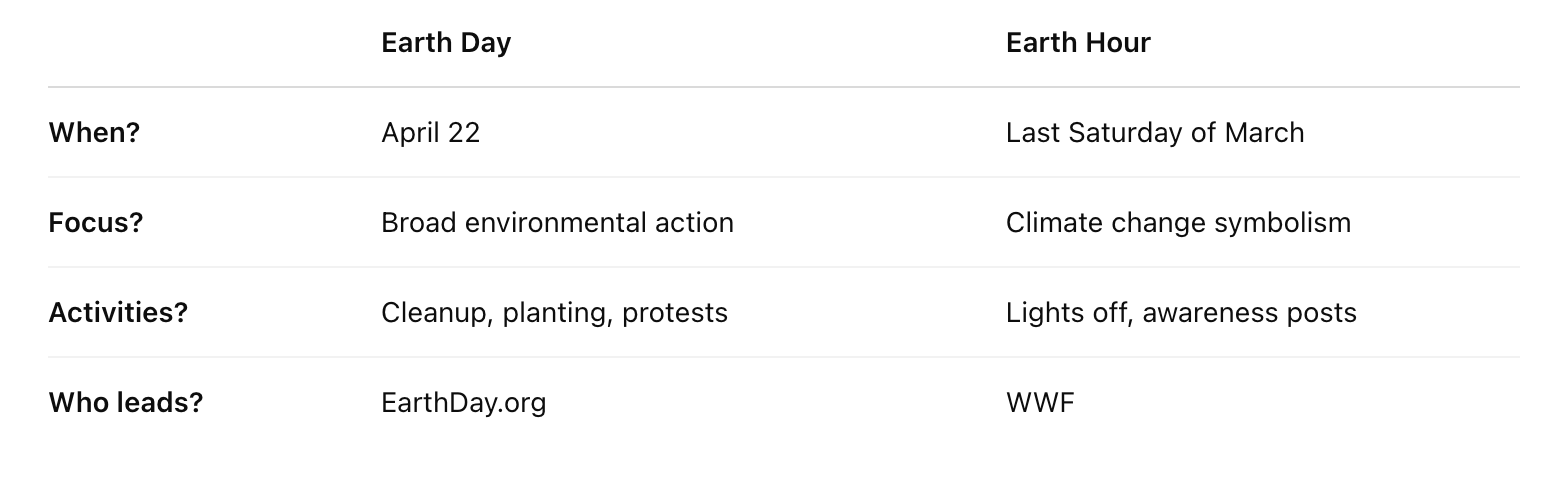
Earth Day is April 22, and it’s about education, action, and awareness on a wide range of environmental issues — from climate to conservation.
Earth Hour, on the other hand, is a global lights-out event usually held in March. It’s more symbolic, asking people to turn off their lights for one hour to show unity for the planet.
Here’s a quick breakdown: